



What's Happening?
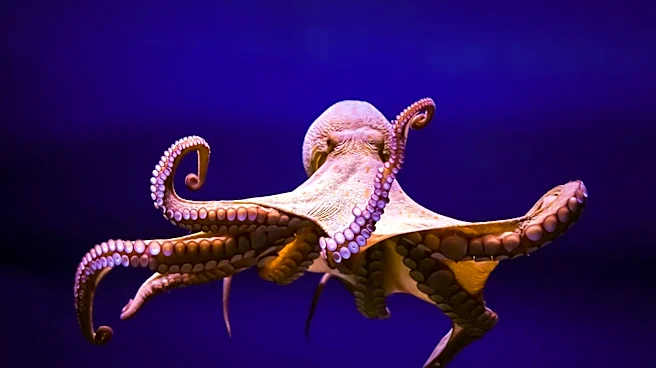
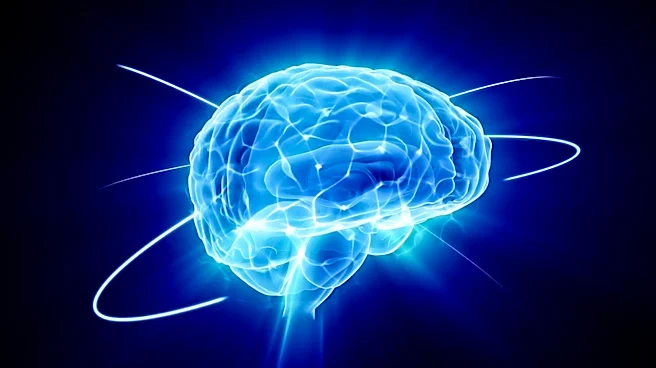
Recent research has revealed that octopuses possess a unique form of distributed intelligence, with over two-thirds of their neurons located in their arms rather than their central brain. This anatomical feature allows each arm to operate semi-independently,
enabling complex behaviors such as unscrewing jars and exploring the seafloor. The nerve ring connecting the arms facilitates coordination without direct input from the central brain, highlighting the sophisticated neural architecture of these cephalopods. Scientists continue to study the implications of this distributed intelligence, which challenges traditional notions of centralized brain function in animals.
Why It's Important?
The discovery of distributed intelligence in octopuses provides valuable insights into the evolution of neural systems and cognitive abilities in animals. Understanding how octopuses process information and coordinate complex behaviors could inform the development of advanced robotics and artificial intelligence systems. The study of octopus intelligence also contributes to broader discussions about animal cognition and the diversity of neural architectures in the animal kingdom. This research may lead to new approaches in neuroscience and inspire innovative designs in technology and engineering.
What's Next?
Further research is needed to explore the full extent of octopus intelligence and the specific mechanisms underlying their distributed neural systems. Scientists may investigate how octopuses learn and adapt to their environments, potentially uncovering new principles of neural plasticity and adaptation. Additionally, the study of octopus intelligence could lead to collaborations between biologists, neuroscientists, and engineers to apply these findings to technological advancements. As interest in animal cognition grows, octopuses may become a focal point for interdisciplinary research efforts.