










What's Happening?
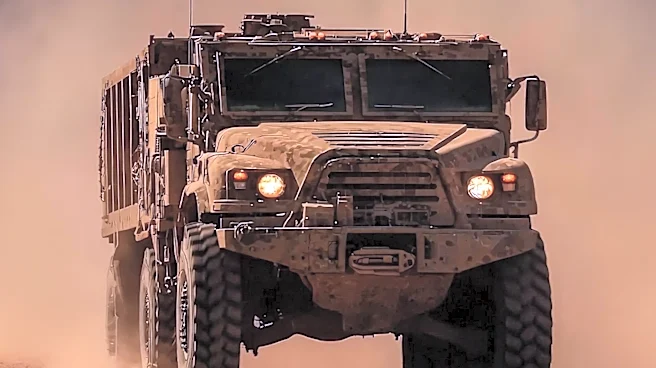
The ongoing conflict in Ukraine has underscored the necessity for military vehicles to possess high mobility and agility to survive modern warfare's demands, such as drones and precision-guided munitions. European armed forces are investing in modernizing
their armored fleets to ensure rapid relocation capabilities, which are crucial for combat effectiveness. The Leopard series of tanks, equipped with the mtu MB 873 engine, exemplifies this trend by delivering 1,500 horsepower to maintain maneuverability despite increased weight. This engine has been widely adopted across Europe, with approximately 4,000 units produced, supporting interoperability among allied forces. The need for enhanced mobility is further emphasized by the challenges posed by Europe's infrastructure, which can hinder the swift deployment of heavy military equipment.
Why It's Important?
The emphasis on mobility and agility in military vehicles is critical for maintaining operational effectiveness in modern warfare. As military technology advances, vehicles are becoming heavier due to improved armor and advanced systems, necessitating powerful engines to maintain mobility. This capability is vital for NATO allies to respond quickly to threats and support each other in crises. The Leopard tanks' widespread use and the ongoing procurement of mtu engines highlight the strategic importance of reliable propulsion systems. These developments ensure that European forces can maneuver effectively, even when traditional routes are compromised, thereby enhancing their deterrence and battlefield capabilities.
What's Next?
Future combat vehicle programs, such as the Main Ground Combat System (MGCS), are expected to demand even greater mobility. Germany and France plan to procure the MGCS as a successor to the Leopard 2, with a focus on lighter, more agile designs. The MGCS will feature a new mtu 10V 199 engine, offering substantial mechanical output while reducing weight. This approach aims to improve deployability in regions with infrastructure limitations. As these programs progress, the challenge will be to balance increased vehicle complexity with the need for mobility, ensuring that modern forces remain adaptable and effective in diverse operational environments.