




What's Happening?
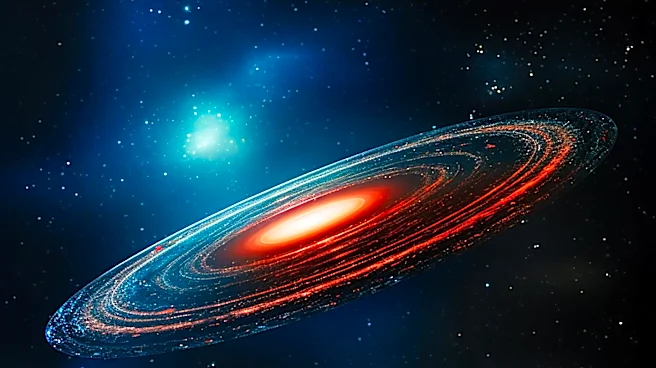
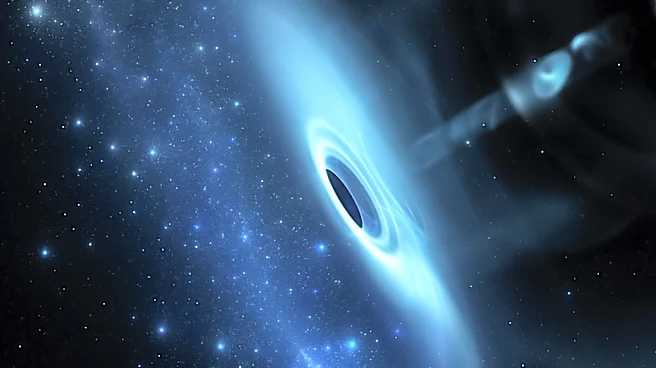
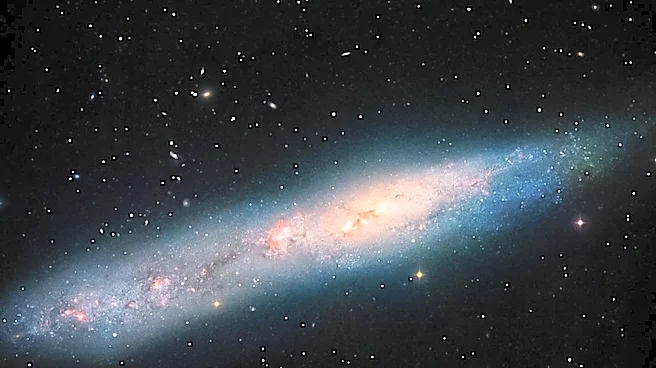
Astronomers have identified a supermassive black hole that is significantly distant from the center of its host galaxy, marking the most extreme example of a wandering black hole discovered to date. This black hole was detected by Robert Stein and his team
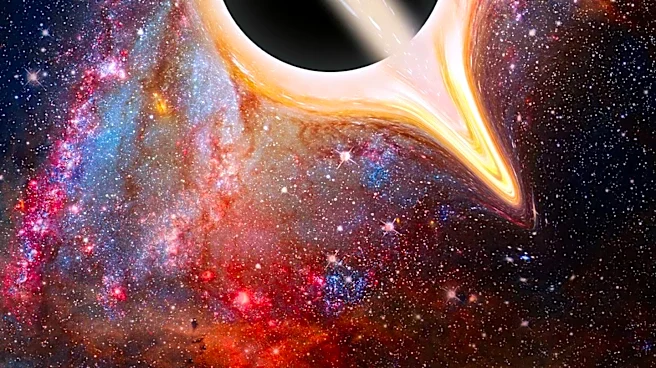
at the University of Maryland during a tidal disruption event (TDE), where a star was consumed by the black hole. The event was initially identified by a machine learning algorithm analyzing data from the Zwicky Transient Facility in California. Follow-up observations confirmed the black hole's presence. This particular TDE, named TDE 2025abcr, is located more than 30,000 light years from the galaxy's center, which is further than the distance of our solar system from the center of the Milky Way. Such wandering black holes are believed to originate from galactic mergers, where one of the central black holes is ejected from the center.
Why It's Important?
The discovery of wandering supermassive black holes provides valuable insights into the history and evolution of galaxies. By understanding the number and distribution of these black holes, scientists can infer the frequency of galactic mergers and the subsequent growth patterns of galaxies. This knowledge is crucial for constructing models of galactic formation and evolution. The detection of such black holes is challenging due to their dark nature, but projects like the Zwicky Transient Facility and the upcoming Legacy Survey of Space and Time at the Vera Rubin Observatory are expected to uncover many more instances, enhancing our understanding of the universe's structure.
What's Next?
The ongoing and future surveys, such as the Legacy Survey of Space and Time, are anticipated to discover hundreds more wandering supermassive black holes. These findings will contribute to a more comprehensive understanding of galactic dynamics and the role of black holes in cosmic evolution. As the light from the current TDE fades, further observations may reveal more about the surrounding environment of this black hole, potentially identifying a cluster of stars gravitationally bound to it. This continued research will help refine theories about the formation and behavior of supermassive black holes.