



What's Happening?
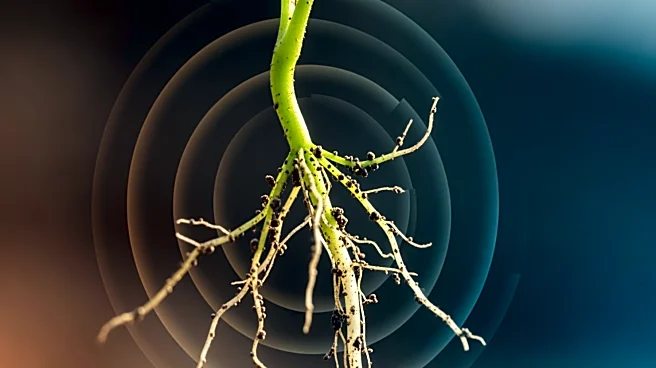
Research from the Salk Institute has revealed a mechanism by which plants adapt to temperature changes through root growth. This mechanism involves the Auxin Response Factor transcription factors (ARFs), which act as sensors of temperature changes. ARFs accumulate
in inactive forms within plant cells at low temperatures and become soluble as temperatures rise, activating gene networks that promote root growth. This discovery provides insight into how plants manage growth in response to environmental changes, offering a potential solution to agricultural challenges posed by climate change.
Why It's Important?
Understanding the molecular mechanisms of plant adaptation to temperature changes is crucial for agricultural sustainability, especially in the face of climate change. The ability to engineer crops with enhanced resilience to heat could secure food production in hotter climates. This research highlights the potential for manipulating ARF thermostability to develop cultivars capable of maintaining efficient water and nutrient uptake under elevated temperatures, addressing global food security concerns.
What's Next?
Future research may explore whether similar temperature-sensing mechanisms exist for other plant hormones, potentially leading to broader applications in plant biology. The collaboration between the Salk Institute and the University of Buenos Aires exemplifies the benefits of international scientific cooperation, which could accelerate further discoveries in this field.
Beyond the Headlines
The study shifts the understanding of hormone-driven growth regulation by positioning ARFs as primary thermal sensors within the auxin signaling cascade. This discovery opens new avenues for research across biological kingdoms, emphasizing the role of protein phase separation in environmental sensing.