
What's Happening?
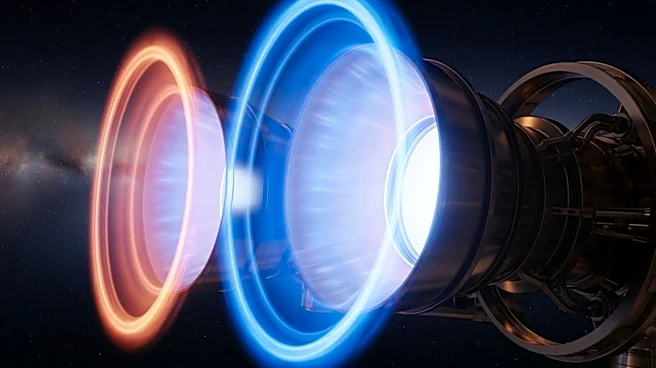
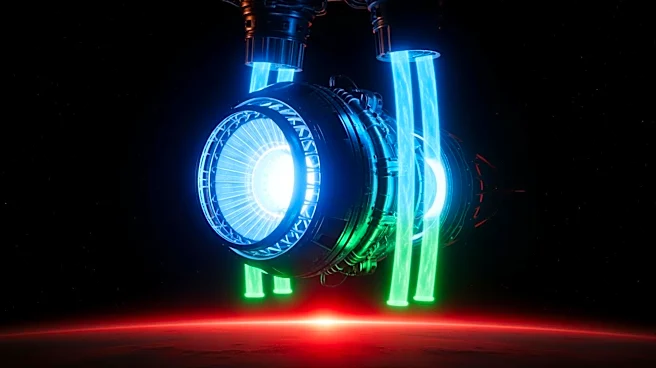
NASA's Jet Propulsion Laboratory (JPL), in collaboration with Princeton University and NASA's Glenn Research Center, has successfully tested a prototype magnetoplasmadynamic (MPD) electric propulsion thruster.
This thruster is 25 times more powerful than the one used in NASA's Psyche mission and is part of the Space Nuclear Propulsion (SNP) program. The test marks the first time in the U.S. that an electric propulsion system has operated at such high power levels, reaching up to 120 kilowatts. The MPD thruster uses lithium metal vapor as a propellant and could potentially carry humans to Mars, offering significant cost savings over conventional rockets by using up to 90% less propellant.
Why It's Important?
The successful test of the MPD thruster represents a significant advancement in space propulsion technology, potentially reducing the cost and increasing the efficiency of future Mars missions. By using less propellant, the technology could lower launch mass and support larger payloads, making human missions to Mars more feasible. This development aligns with NASA's long-term goal of sending astronauts to Mars, and the strategic investments in electric propulsion could propel the next giant leap in space exploration.
What's Next?
NASA plans to continue developing the MPD thruster technology, addressing challenges such as the high temperatures emitted during operation. The agency aims to achieve power levels between 500 kilowatts and 1 megawatt per thruster, which are necessary for a Mars mission. Future spacecraft designs may incorporate multiple MPD thrusters to meet the power requirements for reaching Mars efficiently.