
What's Happening?
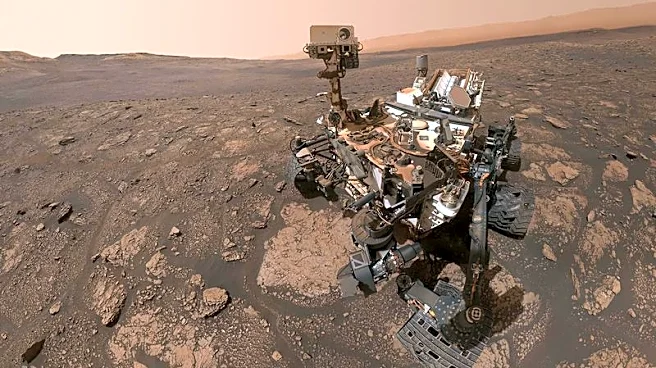
NASA's Curiosity Mars rover has been exploring the Gale crater and Mount Sharp since its landing on August 6, 2012. Recently, the rover has made a significant discovery in the Glen Torridon region of Gale crater,
a site believed to have once had conditions favorable for life. The rover's Sample Analysis at Mars instrument suite has detected over 20 organic molecules from clay-bearing sandstones. These molecules are considered building blocks for the origin of life on Earth. This marks the first time such a chemical experiment has been conducted on another planet, highlighting the potential for life on Mars.
Why It's Important?
The discovery of organic molecules on Mars is crucial as it suggests that the planet may have once harbored life or could potentially support life in the future. This finding enhances our understanding of the conditions necessary for life and the possibility of life beyond Earth. It also underscores the importance of continued exploration and research on Mars, which could lead to groundbreaking discoveries about the planet's history and its capacity to support life. The presence of these molecules could influence future missions and the development of technologies aimed at detecting life on Mars.
What's Next?
Future missions to Mars are likely to focus on further exploration of the Gale crater and other regions that may have been conducive to life. NASA and other space agencies may prioritize the development of advanced instruments and technologies to detect and analyze organic compounds on Mars. Collaborative efforts between humans and robots could enhance exploration capabilities, providing more comprehensive data on the planet's potential for life. These missions could pave the way for human exploration and settlement on Mars, as understanding its ability to support life is crucial for long-term habitation plans.
Beyond the Headlines
The discovery of organic molecules on Mars raises ethical and philosophical questions about the existence of life beyond Earth. It challenges our understanding of life's uniqueness and prompts discussions about the implications of finding extraterrestrial life. Additionally, this discovery could influence international space policies and collaborations, as nations may seek to protect potential Martian ecosystems. The findings also contribute to the broader scientific discourse on astrobiology and the search for life in the universe, encouraging interdisciplinary research and innovation.