


What's Happening?
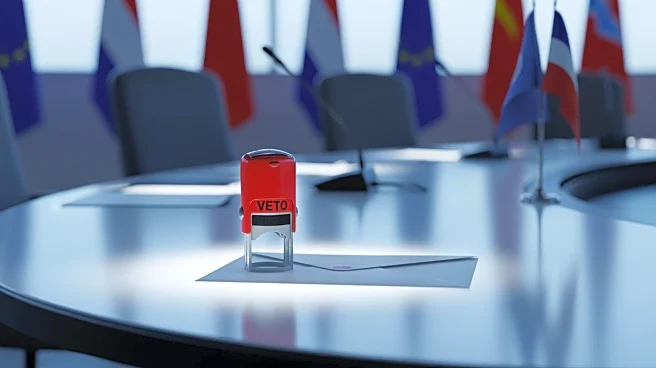
European Commission President Ursula von der Leyen has pledged to ensure the delivery of a €90 billion loan to Ukraine, despite opposition from Hungary. During a summit in Brussels, EU leaders were unable to persuade Hungarian Prime Minister Viktor Orbán
to lift his blockade on the loan, which is crucial for supporting Ukraine's war efforts against Russia. The Kremlin has stated that talks between Washington, Moscow, and Kyiv are on hold due to the Iran conflict, but Ukrainian President Volodymyr Zelenskyy announced that new discussions are expected soon. Additionally, the International Monetary Fund (IMF) is in Kyiv to discuss fiscal reforms and tax changes required under a new $8.1 billion lending program.
Why It's Important?
The EU's commitment to providing financial support to Ukraine is significant in the context of ongoing geopolitical tensions and the war with Russia. Hungary's blockade highlights internal EU divisions, which could impact the bloc's ability to present a united front against Russian aggression. The financial aid is vital for Ukraine's economy and military efforts, and the IMF's involvement underscores the international community's support for Ukraine's economic stability. The situation also reflects broader geopolitical dynamics, with the EU and the U.S. playing key roles in supporting Ukraine against Russian advances.
What's Next?
The upcoming discussions between Ukrainian and U.S. negotiators could potentially revive stalled talks on Russia's invasion, influencing future diplomatic and military strategies. The EU may explore alternative methods to bypass Hungary's blockade, ensuring the delivery of the loan to Ukraine. The IMF's ongoing engagement with Ukrainian authorities will likely focus on implementing necessary economic reforms, which could have long-term implications for Ukraine's financial health and its integration into European economic structures.