
What's Happening?
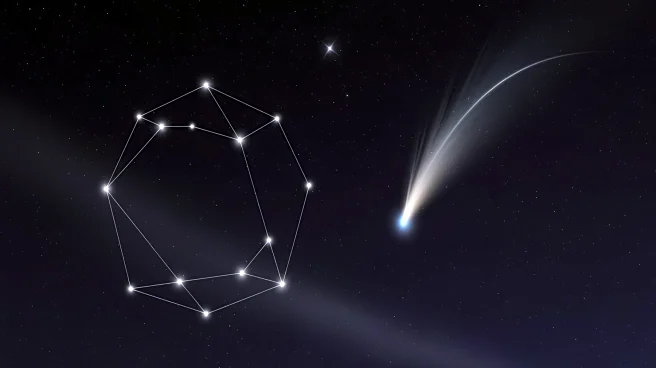
Astronomy enthusiasts are in for a treat as the Winter Hexagon, a large asterism consisting of seven bright stars across six constellations, becomes fully visible above the eastern horizon by 9 P.M. local
time. The stars include Sirius, Rigel, Aldebaran, Capella, Castor, Pollux, and Procyon. Additionally, Comet 24P/Schaumasse, recently observed at magnitude 10, will be located in northern Virgo, rising shortly before midnight on January 4 and best viewed in the hours preceding dawn. The comet will be situated near the globular clusters M53 and NGC 5053 on the morning of January 5. The astronomical data for January 3 indicates a Waning Gibbous Moon at 96% illumination, with specific local times provided for sunrise, sunset, moonrise, and moonset from 40° N 90° W.
Why It's Important?
The visibility of the Winter Hexagon and Comet 24P/Schaumasse offers a unique opportunity for amateur astronomers and sky watchers to observe significant celestial events. The Winter Hexagon is a prominent feature in the winter sky, providing a guide to identifying major stars and constellations. Observing Comet Schaumasse near globular clusters adds to the richness of the sky, allowing for a deeper understanding of celestial dynamics. These events can inspire interest in astronomy and provide educational opportunities for schools and communities, fostering a greater appreciation for science and the natural world.
What's Next?
As the Winter Hexagon remains visible throughout the winter months, sky watchers can continue to enjoy its presence in the night sky. Comet 24P/Schaumasse will continue its journey through Virgo, offering further opportunities for observation, especially for those equipped with larger telescopes or astrophotography equipment. The ongoing visibility of these celestial events may lead to increased public interest in astronomy and potential community events centered around stargazing.