






What's Happening?
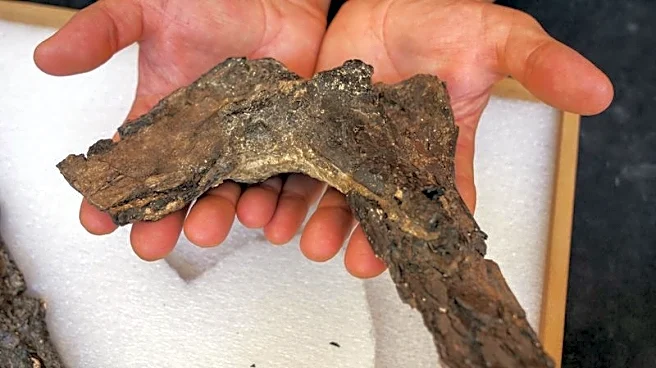
Scientists have reported the strongest evidence to date of red blood cells within a dinosaur fossil. The discovery was made in bone from the right leg of an Aratasaurus museunacionali, a medium-sized meat-eating dinosaur that lived in Brazil approximately
115 million years ago during the Cretaceous Period. Researchers identified numerous microscopic structures resembling fossilized red blood cells within the vascular canals of the bone. Additionally, chemical evidence of heme, an iron-containing biomolecule associated with hemoglobin, was detected. Kliti Grice, an organic and isotope geochemist at Curtin University in Perth, Australia, and lead author of the study published in the journal Proceedings of the National Academy of Sciences, emphasized that this is not intact dinosaur blood but rather a 'mineral and molecular echo of ancient biology.' The Aratasaurus individual was estimated to be a juvenile or young adult, about 4 years old, and measured approximately 10 feet long.
Why It's Important?
This discovery is significant because soft tissues and cellular structures are rarely preserved in fossils, unlike bones and teeth. The presence of red blood cell-like structures and chemical evidence of heme provides unprecedented insights into the biology of dinosaurs at a cellular level. While the research does not indicate the survival of dinosaur DNA, it pushes the boundaries of what is believed to be possible regarding molecular preservation over vast geological timescales. This finding could open new avenues for paleontological research, allowing scientists to glean more detailed biological information from ancient life forms. Understanding the cellular composition of dinosaurs can enhance our knowledge of their physiology, metabolism, and evolutionary history, offering a more complete picture of these extinct creatures. It challenges previous assumptions about the degradation rate of biological information, encouraging further exploration into molecular preservation.
What's Next?
The findings encourage scientists to continue testing the limits of molecular preservation in fossils, rather than assuming all biological information must disappear after a certain period. Future research may focus on applying similar analytical techniques to other dinosaur fossils to determine if such cellular and molecular echoes are more common than previously thought. This could lead to a broader understanding of the preservation conditions necessary for such delicate biological remnants. The methodology used in this study, combining structural and chemical evidence, could become a standard for investigating ancient biological materials. While the discovery does not imply the recovery of intact DNA, it may inspire new approaches to studying the molecular components of ancient life, potentially revealing more about the evolutionary pathways and physiological characteristics of dinosaurs and other extinct species.
Beyond the Headlines
This scientific breakthrough has profound implications beyond paleontology, touching upon our understanding of life's resilience and the processes of fossilization. The ability of complex biomolecules like heme to persist for millions of years, even in a 'molecular echo' form, challenges conventional wisdom about decay and preservation. It highlights the intricate interplay between geological processes and biological chemistry, suggesting that under specific conditions, more detailed biological information might be retained than previously imagined. This discovery could also fuel public imagination about the possibility of uncovering even more detailed biological secrets from ancient life, though scientists caution against misinterpreting these findings as a step towards de-extinction. Ethically, it reinforces the importance of careful and responsible scientific interpretation, distinguishing between preserved molecular remnants and intact genetic material, to manage public expectations and avoid speculative claims.