




What's Happening?
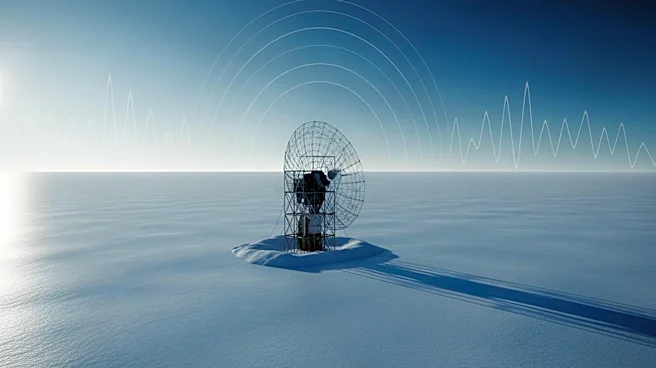
A scientific breakthrough has been achieved by the Askaryan Radio Array (ARA) Collaboration, which has successfully detected radio pulses generated by high-energy cosmic rays interacting with Antarctic ice. This phenomenon, predicted by Soviet physicist
Gurgen Askaryan in 1962, involves the creation of radio waves when high-energy particles pass through dense materials like ice, triggering particle cascades. The ARA, located near the South Pole, consists of five stations equipped with radio antennas embedded deep in the ice. During a 208-day observation period in 2019, the team recorded 13 anomalous radio signals that matched the characteristics of Askaryan radiation. The statistical significance of these findings was 5.1 sigma, indicating a very low probability of the signals being mere background noise.
Why It's Important?
This discovery is significant as it validates a key technique for detecting some of the universe's rarest and most energetic particles, specifically ultrahigh-energy cosmic neutrinos. The ability to distinguish between signals from cosmic rays and neutrinos is crucial for advancing our understanding of cosmic phenomena. The ARA's success in capturing these signals demonstrates the potential for further discoveries in particle physics and astrophysics. This could lead to new insights into the origins and behavior of cosmic rays and neutrinos, which are fundamental to understanding the universe's composition and evolution.
What's Next?
The ARA team is preparing for a new data release that will cover observations from all five stations over several years. This expanded dataset is expected to yield up to seven candidate neutrino events, further enhancing the array's capability to detect and study ultrahigh-energy cosmic neutrinos. Continued analysis and refinement of detection techniques will be essential for distinguishing between cosmic ray and neutrino signals, potentially leading to groundbreaking discoveries in the field of astrophysics.
Beyond the Headlines
The successful detection of Askaryan radiation in ice not only confirms a long-standing scientific prediction but also highlights the importance of international collaboration in scientific research. The ARA's findings underscore the potential for innovative technologies to unlock new frontiers in science, offering a glimpse into the universe's most elusive particles. This development may also inspire further investment in similar detection arrays, fostering advancements in both theoretical and experimental physics.