




What's Happening?
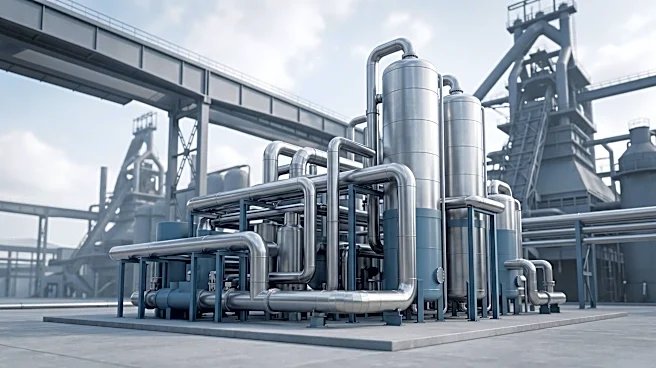
Global mining major Rio Tinto has commissioned a pilot carbon capture facility at Chinese steelmaker Shougang Group’s Jingtang plant. This facility is designed to capture carbon dioxide directly from blast furnace gas, processing up to 3,000 cubic meters
of gas per hour with an annual capture capacity of up to 10,000 metric tons of CO2 during its testing phase. The commissioning marks a key milestone under a memorandum of understanding signed by Rio Tinto and Shougang in 2022, which focuses on researching and deploying low-carbon technologies across the ironmaking and steelmaking value chains. The trial aims to generate operational data on solvent performance, energy consumption, and gas pre-treatment requirements when processing raw blast furnace off-gases, with the ultimate goal of evaluating the technical and economic feasibility of scaling commercial Carbon Capture, Utilization, and Storage (CCUS) retrofit solutions within China's steel sector.
Why It's Important?
This carbon capture trial by Rio Tinto at a Chinese steel plant holds significant implications for U.S. industries and global climate efforts. As Scope 3 emissions pressure increases on iron ore mining companies, direct technology trials with primary steel producers become crucial for safeguarding long-term demand for high-grade iron ore. For the U.S. steel industry, which is also under pressure to decarbonize, the success of such pilot projects could provide valuable insights and accelerate the adoption of similar technologies. Blast furnaces remain a dominant source of emissions in primary steel production, making point-source carbon capture a vital transitional technology while direct reduced iron (DRI) and green hydrogen pathways scale up globally. The data generated from this trial could inform policy decisions, investment strategies, and technological advancements in the U.S., helping to reduce the carbon footprint of its own steel production and related supply chains, thereby impacting economic stakeholders and environmental policy.
What's Next?
The pilot carbon capture facility at Shougang Group’s Jingtang plant will continue its testing phase, focusing on collecting operational data regarding solvent performance, energy consumption, and gas pre-treatment. The findings from this trial will be crucial for evaluating the technical and economic feasibility of scaling commercial CCUS retrofit solutions across China’s steel sector. If successful, this could lead to broader implementation of carbon capture technologies in steel plants, potentially influencing global standards and practices for decarbonization in heavy industry. Rio Tinto and Shougang will likely use the data to refine the technology and explore further deployment, which could also inform similar initiatives in other major steel-producing regions, including the U.S., as they seek to reduce industrial emissions.
Beyond the Headlines
The collaboration between Rio Tinto and Shougang Group on carbon capture technology transcends a mere industrial trial; it represents a critical step in addressing the 'hard-to-abate' emissions from the global steel industry. This initiative highlights the ethical responsibility of major corporations to invest in sustainable practices, especially given the significant environmental impact of steel production. The trial's success or failure could influence the pace of decarbonization across the entire industrial sector, potentially accelerating the transition to a low-carbon economy. Culturally, it signifies a growing international recognition of shared environmental challenges and the necessity of cross-border partnerships to develop and deploy solutions. The long-term implications include a potential redefinition of 'clean steel' and the establishment of new industry benchmarks, which could reshape global trade dynamics and consumer expectations for environmentally responsible products, impacting U.S. manufacturers and consumers alike.