




What's Happening?
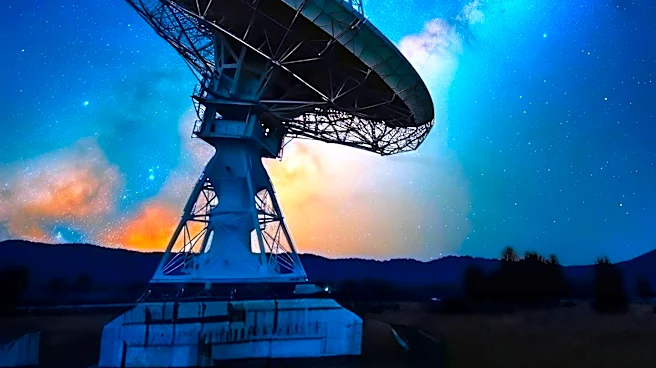
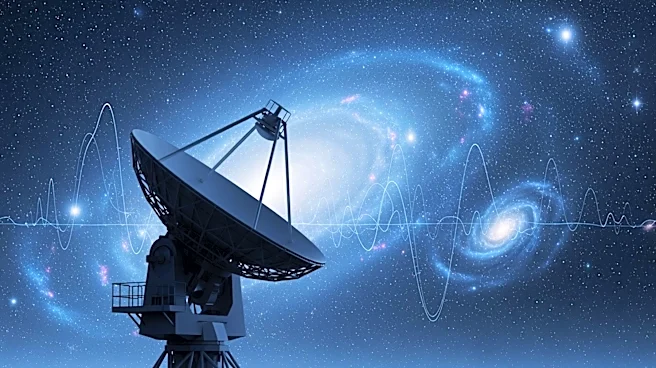
Researchers using the Atacama Cosmology Telescope (ACT) have confirmed that gravity behaves as predicted by Newton's and Einstein's theories even at vast cosmic distances. The study, led by Patricio A. Gallardo from the University of Pennsylvania, tested
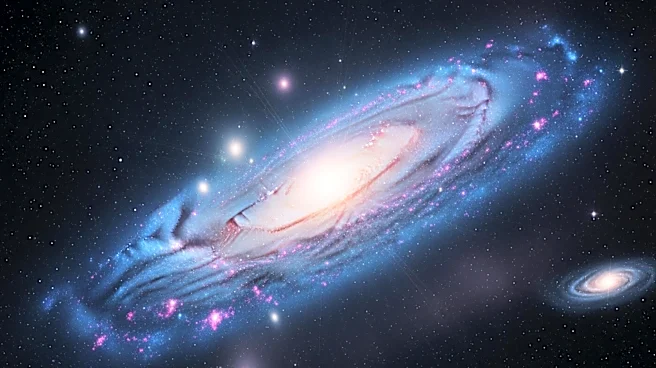
gravity across galaxy clusters separated by hundreds of millions of light-years. The findings, published in Physical Review Letters, show that gravity's strength weakens with distance almost exactly as predicted by the inverse square law. This research effectively challenges theories like Modified Newtonian Dynamics (MOND) that suggest gravity behaves differently on large scales. The study reinforces the standard model of cosmology by confirming that fundamental theories of gravity do not break down on the largest scales.
Why It's Important?
This confirmation of gravity's consistency is significant for the field of cosmology as it supports the existence of dark matter, an unseen component believed to provide the extra gravitational pull observed in cosmic structures. The study strengthens the case for dark matter, which remains one of the biggest mysteries in modern physics. By validating the established theories of gravity, the research closes the door on alternative theories that attempt to explain cosmic motions by modifying gravity. This has implications for our understanding of the universe's structure and evolution, and it guides future research in astrophysics and cosmology.
What's Next?
Future observations of the cosmic microwave background (CMB) and larger galaxy surveys will allow scientists to test gravity even more precisely. These efforts aim to further understand the nature of dark matter and its role in the universe. As researchers continue to explore the universe's 'speed limits' and the behavior of galaxies, the quest to identify the components of dark matter will remain a central focus in cosmological studies. The ongoing research will contribute to a deeper understanding of the universe's fundamental forces and the unseen matter that influences cosmic dynamics.
Beyond the Headlines
The study highlights the enduring relevance of classical physics principles in modern scientific research. The confirmation of gravity's behavior over vast distances underscores the robustness of Newton's and Einstein's theories, which continue to provide a foundation for understanding the universe. This research also emphasizes the importance of advanced observational tools like the ACT in testing and validating scientific theories. The findings contribute to the broader discourse on the nature of the universe and the fundamental forces that govern it, offering insights that could lead to new discoveries in physics and cosmology.