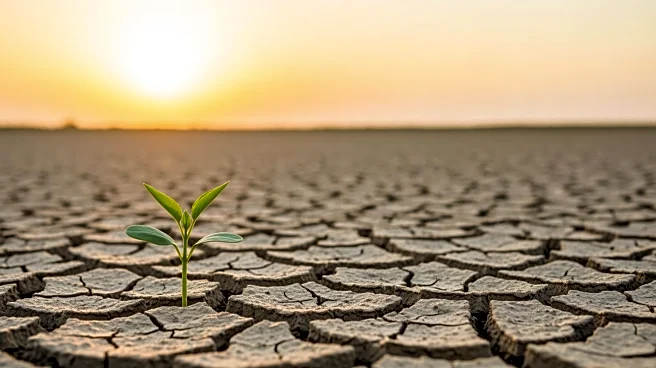




What's Happening?
Global desertification is increasingly turning fertile land into barren landscapes, affecting economies, food security, and social stability worldwide. The phenomenon is driven by climate change, deforestation, and intensive land use, leading to soil
degradation and the displacement of populations. The Gobi Desert, for instance, expands by thousands of square kilometers annually, forcing families to abandon their homes. However, scientific and agricultural innovations show promise in reversing these trends. Projects in arid regions, such as Saudi Arabia, demonstrate that food production is possible in deserts through deep irrigation, though this method is not sustainable long-term due to excessive groundwater use. Regenerative agriculture, which captures and redirects water to restore vegetation, offers a more sustainable approach. Additionally, renewable energy projects, like solar and wind farms, could potentially alter climate patterns to increase rainfall in dry areas, though their high costs and logistical challenges limit immediate implementation.
Why It's Important?
The acceleration of global desertification poses a significant threat to billions of people who rely on land for their livelihoods. As productive land diminishes, the risk of food insecurity and economic instability increases, potentially leading to more environmental migrants and humanitarian crises. The efforts to combat desertification through science and agriculture are crucial in mitigating these impacts. Successful projects, such as reforestation in China's Kubuqi Desert, demonstrate that with strategic planning and investment, it is possible to restore degraded lands. These initiatives not only improve local ecosystems but also enhance air quality and revive economic activities. However, the financial and political challenges of scaling these solutions globally remain significant, emphasizing the need for coordinated international efforts to address the root causes of desertification.
What's Next?
Future efforts to combat desertification will likely focus on expanding successful pilot projects and integrating traditional agricultural practices with modern technology. Governments and international organizations may need to prioritize funding and policy support for sustainable land management practices. Additionally, the development of renewable energy projects could play a dual role in providing clean energy and mitigating climate impacts in arid regions. However, achieving these goals will require overcoming significant financial and logistical barriers, as well as fostering international cooperation to address the broader environmental and economic challenges posed by desertification.
Beyond the Headlines
The fight against global desertification highlights the complex interplay between environmental sustainability and economic development. While technological solutions offer hope, they also raise ethical questions about resource allocation and the potential for unintended environmental consequences. The reliance on groundwater for irrigation, for example, underscores the need for sustainable water management practices. Moreover, the integration of traditional knowledge with modern science presents an opportunity to create more resilient agricultural systems that respect local ecosystems. As the world grapples with the impacts of climate change, the lessons learned from combating desertification could inform broader strategies for sustainable development and environmental stewardship.