


What's Happening?
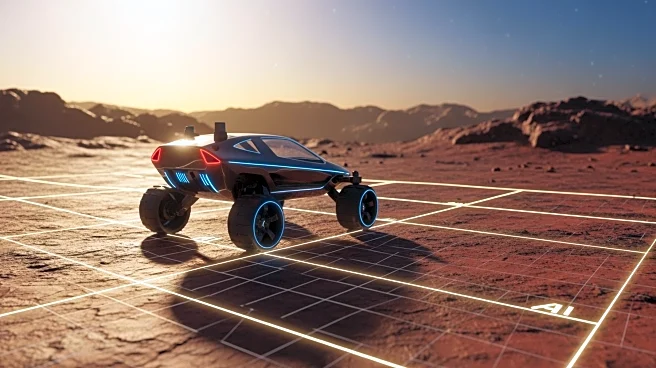
NASA has employed Anthropic's Claude machine learning model to plan a route for the Perseverance rover on Mars. The AI-generated path allowed the rover to travel approximately 400 meters on the Martian surface, with NASA's Jet Propulsion Laboratory overseeing
the process. Claude analyzed high-resolution orbital imagery and terrain data to identify critical features and generate a continuous path with waypoints. This approach aims to reduce the time-consuming and laborious task of route planning, traditionally handled by human engineers. The AI's involvement marks a significant step in utilizing autonomous technologies for space exploration, potentially increasing efficiency and scientific return.
Why It's Important?
The integration of AI in space exploration signifies a technological advancement that could enhance mission efficiency and reduce human workload. By automating route planning, NASA can focus on other critical aspects of exploration, potentially accelerating scientific discoveries. This development also highlights the growing role of AI in real-world applications, demonstrating its capability to handle complex tasks in challenging environments. As AI models become more sophisticated, they may play a larger role in future missions, supporting autonomous operations and expanding the scope of exploration.
What's Next?
NASA's successful use of AI for rover navigation may lead to further adoption of autonomous technologies in space missions. As AI models improve, they could be integrated into other aspects of exploration, such as data analysis and decision-making. This advancement may also prompt collaborations between AI developers and space agencies, fostering innovation and expanding the possibilities for interplanetary exploration.