





What's Happening?
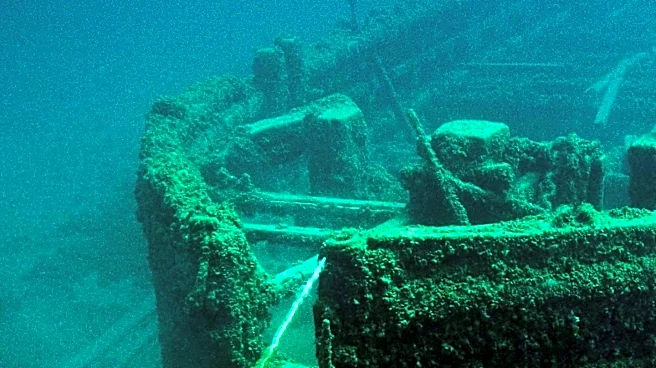
The wreckage of the Altalena, an Irgun ship shelled in 1948 during Israel's War of Independence, has been located intact at a depth of 503 meters (1,650 feet) off the Israeli coast. Following this discovery, Prime Minister Benjamin Netanyahu stated that
the ship would be 'raised from the depths of the sea.' However, maritime professionals and academic experts are largely dismissing the feasibility of salvaging the entire vessel. They argue that the ship, having been submerged for nearly 80 years, has undergone extensive corrosion and is likely to disintegrate if attempts are made to lift it. The Heritage Ministry, responsible for the search operation, focused solely on locating the ship and did not outline plans for its recovery. Experts suggest that at most, robots could be used to retrieve a symbolic section, such as the bridge or part of the deck, due to the severe challenges involved.
Why It's Important?
The debate surrounding the Altalena's recovery highlights a significant historical and nationalistic sentiment in Israel, as the ship represents a pivotal and controversial moment in the nation's founding. The incident, where then-Prime Minister David Ben-Gurion ordered the shelling of the ship carrying immigrants and military equipment, resulted in 19 deaths and remains a sensitive topic. While Prime Minister Netanyahu's pledge to raise the ship resonates with a desire to preserve national heritage, experts' warnings underscore the practical and financial realities of such an undertaking. The potential for the ship to crumble upon recovery could lead to an embarrassing outcome, undermining the intended memorial. This situation also brings to light the broader challenge of balancing historical preservation with environmental concerns and economic prudence, especially when dealing with deep-sea wrecks that have become part of the marine ecosystem.
What's Next?
Despite Prime Minister Netanyahu's public statement, the immediate next steps for the Altalena's recovery remain unclear, especially given the strong expert consensus against a full salvage operation. It is likely that further discussions will occur within the Israeli government and with maritime and historical experts to determine a realistic course of action. Options could include commissioning a detailed assessment of the ship's structural integrity and the feasibility of partial recovery. Alternatively, the focus might shift towards establishing an underwater memorial or retrieving a small, symbolic piece for display, similar to what was done with the INS Dakar submarine. The cost implications, estimated to be in the tens of millions of dollars for a full recovery versus $1-2 million for a symbolic piece, will undoubtedly play a significant role in future decisions. Public and political pressure to honor the ship's historical significance will likely continue to influence the debate.
Beyond the Headlines
The Altalena incident is more than just a historical event; it represents a deep-seated political and ideological rift from Israel's early days, symbolizing the struggle between different factions over the nascent state's direction. The ship's recovery, or lack thereof, could reignite these historical debates and influence contemporary political narratives. Ethically, the discussion touches upon the responsibility of a nation to its past and the most respectful way to commemorate tragic events. Environmentally, experts warn that disturbing the wreck could harm marine life, as sunken ships often become artificial reefs. This raises questions about whether historical preservation should sometimes yield to ecological considerations. The situation also serves as a case study in the complexities of deep-sea salvage, where advanced technology meets the unforgiving realities of the ocean environment, challenging even the most determined political will.