



What's Happening?
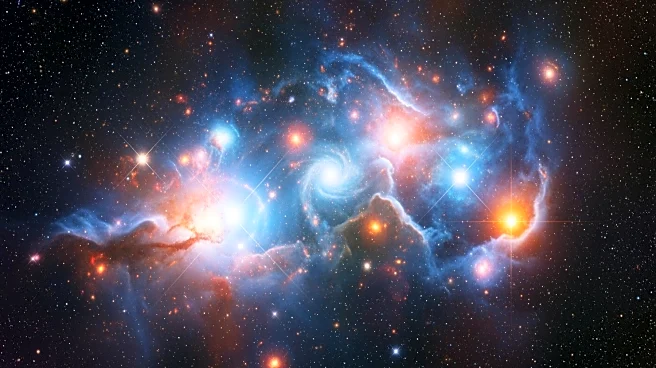
The Hubble Space Telescope has captured new images of protostars in various star-forming regions, providing insights into the formation of massive stars. These images are part of the SOFIA Massive (SOMA) Star Formation Survey, which aims to understand
how stars, particularly those with more than eight times the mass of the Sun, form. The images reveal protostars shrouded in thick dust, with jets of gas and dust creating outflow cavities. These cavities allow near-infrared emissions to escape, offering clues about the structure and properties of these young stars. The survey focuses on regions like Cepheus A, which hosts a collection of infant stars, including a large protostar responsible for much of the region's illumination.
Why It's Important?
Understanding the formation of massive stars is crucial for astrophysics, as these stars play a significant role in the evolution of galaxies. They influence their surroundings through intense radiation and stellar winds, impacting star formation and the interstellar medium. The data from Hubble's observations help refine theories about star formation, particularly the processes that lead to the birth of massive stars. This knowledge can enhance our understanding of the lifecycle of stars and the dynamics of galaxies, contributing to broader astronomical research and potentially informing future space exploration missions.