





What's Happening?
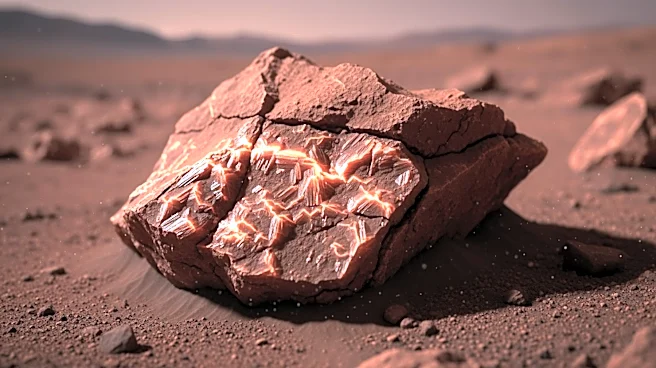
NASA's Curiosity rover has made a significant discovery on Mars, identifying the most diverse set of organic molecules found on the planet to date. This discovery was made from a rock sample collected in 2020 in the Mount Sharp area of Gale Crater, a region
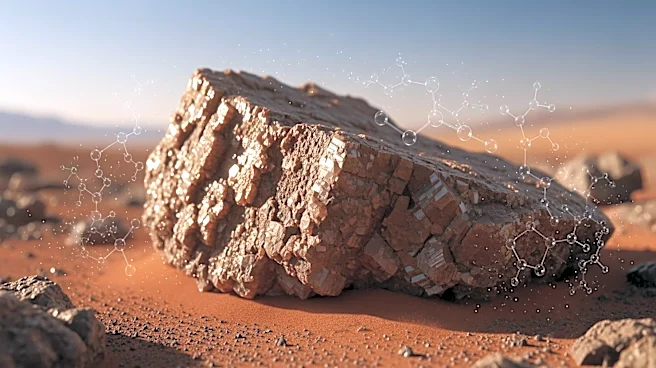
known for its historical presence of lakes and streams. The sample, named after paleontologist Mary Anning, revealed 21 carbon-containing molecules, including seven that were previously undetected on Mars. These findings, published in Nature Communications, do not confirm past life on Mars but provide a deeper chemical framework for understanding ancient Martian environments. The presence of these molecules suggests that Mars had complex organic chemistry, potentially preserved in clay minerals over billions of years.
Why It's Important?
The discovery of diverse organic molecules on Mars is crucial for astrobiology, as it suggests that the planet once had environments conducive to preserving complex chemistry. This finding enhances the understanding of Mars's past, indicating that it had conditions that could have supported life, such as water and stable geological environments. The presence of nitrogen heterocycles and benzothiophene, compounds significant in prebiotic chemistry, highlights the potential for Mars to have hosted chemical processes similar to those that preceded life on Earth. This discovery informs future missions, suggesting that valuable chemical evidence can be found in surface rocks, not just in deep subsurface structures.
What's Next?
The findings from Curiosity's analysis will guide future Mars missions, such as the European Space Agency's Rosalind Franklin rover, which aims to search for signs of past or present life beneath the Martian surface. The success of the wet chemistry experiment using TMAH on Curiosity suggests that similar methods could be employed in future missions to analyze Martian rocks more effectively. Additionally, NASA's upcoming Dragonfly mission to Titan will investigate prebiotic chemistry, using insights gained from Curiosity's findings to explore organic processes on other celestial bodies.
Beyond the Headlines
This discovery underscores the importance of selecting scientifically promising sites for exploration, as Curiosity's targeted drilling in clay-rich areas yielded significant results. The findings also highlight the potential for Mars to have retained chemical records of its past environments, offering a window into the planet's history when it had a thicker atmosphere and more active water processes. The study of these organic molecules not only advances the search for life on Mars but also contributes to the broader understanding of planetary evolution and the conditions necessary for habitability.