




What's Happening?
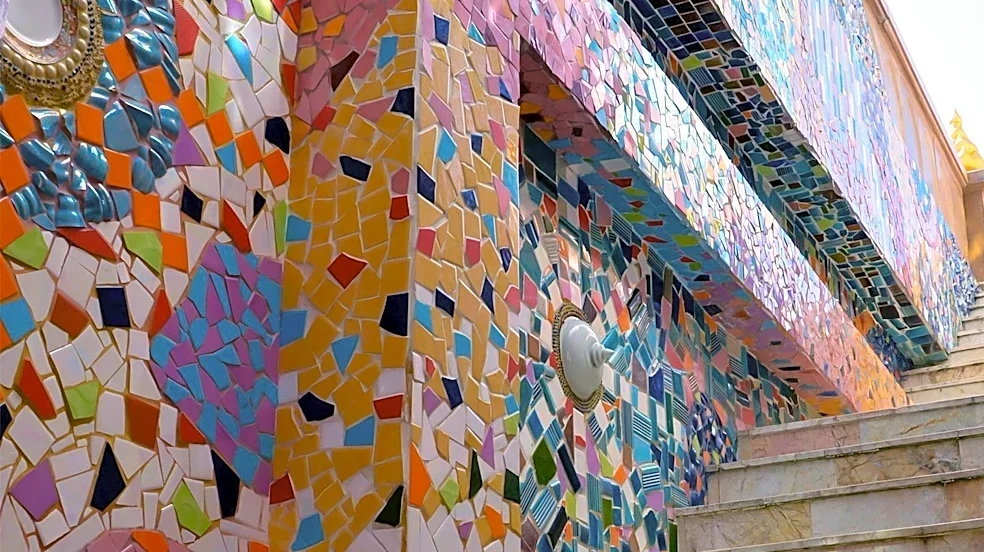
The creation of mosaics, traditionally an art form relying on human eye and hand, is increasingly being influenced by mathematical principles and algorithmic processes. Modern mosaic artists and researchers are employing concepts such as tessellation,
Voronoi diagrams, and quadtrees to precisely divide surfaces and determine tile placement. Tessellation, the covering of a surface without gaps or overlaps, is fundamental to mosaic construction, with mathematics identifying specific regular polygons that can tile a plane. Voronoi diagrams, which partition a surface into regions based on proximity to 'seeds,' are used to create irregular yet fitting cells, mimicking natural patterns. Lloyd's algorithm refines these Voronoi tessellations to achieve cells of nearly equal size or sizes controlled by a density function, allowing for detailed areas to have smaller tiles. Quadtrees offer another method for variable tile sizing, splitting squares into smaller units only where more image detail is required. These mathematical tools enable artists to define the 'grid' of a mosaic with unprecedented precision and control.
Why It's Important?
The integration of mathematics and algorithms into mosaic art signifies a significant evolution in how traditional art forms can leverage technological advancements. This approach allows for the creation of highly complex and detailed mosaics that might be impractical or impossible to achieve through purely manual methods. By formalizing the processes of surface division and tile selection, artists can explore new aesthetic possibilities and achieve greater consistency in their work. The use of perceptual color spaces like CIELAB in algorithmic matching ensures that the chosen tiles accurately reflect human visual perception, enhancing the overall visual impact of the mosaic. This blend of art and science also opens doors for interdisciplinary collaboration, pushing the boundaries of both fields and potentially inspiring new applications in areas like digital imaging, material science, and architectural design. Furthermore, it democratizes the creation of intricate patterns, making sophisticated design principles accessible through computational tools.
What's Next?
Future developments in algorithmic mosaic creation are likely to focus on refining the 'matching problem'—how to select the best tile for each cell. Current methods, such as those using the Hungarian algorithm for assignment problems, aim to minimize the visual 'distance' between the target image and the chosen tiles. Research will continue to explore more sophisticated metrics for color and pattern similarity, potentially incorporating advanced machine learning and computer vision models to 'understand' and replicate artistic intent more accurately. The concept of 'dithering,' which passes on the error of a tile choice to its neighbors, could be further developed to create more nuanced tonal transitions in mosaics with limited tile palettes. Additionally, the application of 'importance maps,' derived from visual attention research, will likely become more prevalent, allowing algorithms to automatically prioritize detail in visually significant areas of an image. This could lead to mosaics that are not only technically precise but also emotionally resonant and visually compelling, mimicking the intuitive decisions of a human artist.
Beyond the Headlines
The philosophical implications of algorithmic art extend beyond mere technical efficiency. The physicist Philip Anderson's concept of 'More Is Different' resonates deeply here: while individual mathematical equations do not contain a 'face,' the collective arrangement of thousands of algorithmically chosen pieces can manifest a recognizable image. This raises questions about authorship, creativity, and the definition of art itself when machines play a significant role in the creative process. While mathematics can define the 'how' of mosaic construction, the 'why'—the artistic intent, the choice of subject, the emotional message—remains firmly in the human domain. The ongoing dialogue between human artistic vision and computational execution will likely shape the future of many art forms, challenging traditional notions of skill and craftsmanship. This evolution also highlights the enduring human fascination with patterns, order, and the ability to create complex beauty from simple, discrete elements, a fascination that spans millennia from ancient pebble mosaics to modern digital art.