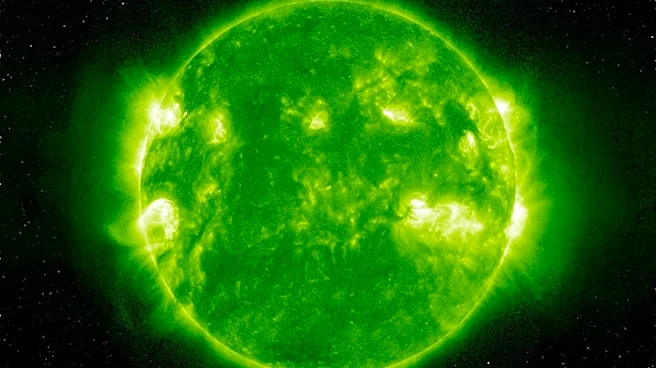








What's Happening?
Researchers have discovered an unusual pattern on the sun that could provide up to a seven-year lead in predicting dangerous solar storms. These storms occur when large amounts of charged particles, magnetic fields, and radiation are ejected from the sun,
potentially disrupting Earth's magnetic field and creating auroras. The most intense solar storms are linked to solar flares and coronal mass ejections. A British research team has identified a point on the sun where extreme space weather abruptly ceases, rather than gradually diminishing. This discovery could significantly improve forecasts for solar storms, which can damage satellites, disrupt navigation systems, and even affect power grids on Earth.
Why It's Important?
The ability to predict solar storms well in advance is crucial for mitigating their potential impacts on technology and infrastructure. Solar storms can cause significant disruptions to satellite operations, communication systems, and power grids, leading to economic losses and safety concerns. By identifying the sun's 'off switch,' scientists can provide earlier warnings, allowing governments, power companies, and satellite operators to take preventive measures. This advancement in space weather forecasting could enhance the resilience of critical systems and reduce the risk of widespread disruptions.
What's Next?
The research team plans to apply their findings to the upcoming solar cycle 26, which is expected to begin between 2029 and 2032. They aim to refine their predictions as the current solar cycle 25 progresses, using the newly identified 'off switch' to make more accurate forecasts. This ongoing research will be crucial for developing strategies to protect infrastructure from the effects of solar storms, ensuring that stakeholders are better prepared for future space weather events.