
What's Happening?
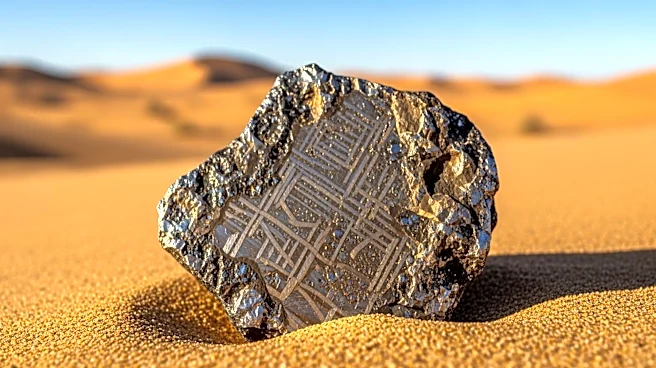
Researchers from the University of Colorado Boulder have identified a fragment found in the Sahara Desert as a remnant of a long-vanished protoplanet. This discovery provides compelling evidence of a large
planetary body that existed in the early Solar System and subsequently disappeared. The fragment, part of the NWA 12774 meteorite, belongs to the Angrites, one of the oldest volcanic rocks in the Solar System. These rocks formed just a few million years after the Solar System's formation, approximately 4.56 billion years ago. The meteorite's unique chemical composition, particularly its low silicon dioxide content, suggests it originated from a large body, possibly as large as the Moon or Mars. The presence of clinopyroxene, a mineral formed under immense pressure, indicates the protoplanet had a radius of at least 1,000 kilometers, with some estimates suggesting it could have been as large as Mars.
Why It's Important?
The discovery of this protoplanet fragment is significant as it challenges existing theories about planetary formation in the early Solar System. The unique composition of the meteorite suggests a distinct evolutionary path for this protoplanet, differing from Earth and Mars. This finding could lead to a reevaluation of how planets form and evolve. Additionally, the study highlights the potential for other unexamined meteorites to reveal more about vanished protoplanets, offering new insights into the history and dynamics of our Solar System. The research underscores the importance of continued exploration and study of meteorites to uncover hidden aspects of planetary science.