



What's Happening?
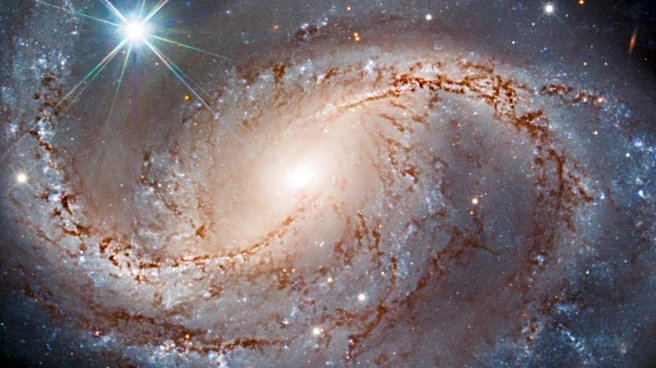
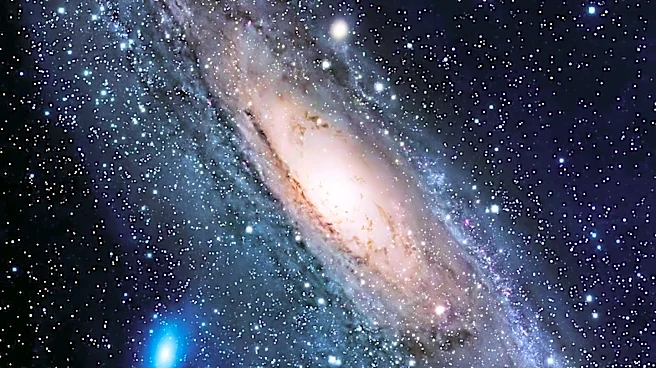
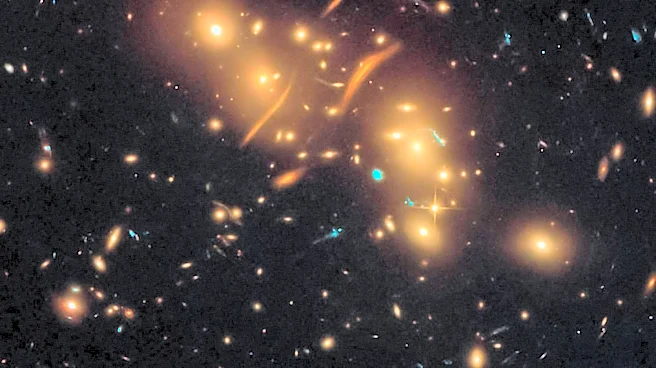
Recent studies have identified a rare population of galaxies that appear to be deficient in dark matter. These galaxies, such as NGC 1052 DF2 and DF4, exhibit low internal velocity dispersions that align with the gravitational influence of their stars
alone, rather than the expected dark matter halo. Various theories have been proposed to explain this phenomenon, including strong tidal stripping and high-speed galactic collisions. These findings challenge existing models of galaxy formation and the role of dark matter in the universe.
Why It's Important?
The discovery of dark matter-deficient galaxies could significantly impact our understanding of galaxy formation and the fundamental nature of dark matter. These galaxies provide a unique opportunity to study the separation of ordinary matter from dark matter, offering insights into the properties and behavior of dark matter. This research could lead to new constraints on dark matter models and influence future cosmological and laboratory studies. Understanding these galaxies may also help refine theories about the universe's structure and the role of dark matter in cosmic evolution.