




What's Happening?
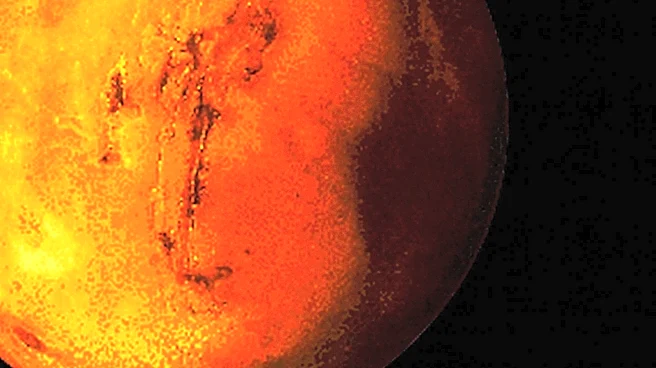
A recent review in Astrobiology suggests that Mars' subsurface may have been a refuge for microbial life as the planet's atmosphere thinned and its surface became inhospitable billions of years ago. The study, led by Devan Nisson, explores the potential
habitats and metabolisms that could exist underground, where conditions might be more favorable for life. The review highlights the challenges of searching for life on Mars, as the environments capable of sheltering life could lie meters or kilometers below the surface, beyond the reach of current spacecraft. The study emphasizes the need for future missions to explore deeper layers to uncover potential biosignatures.
Why It's Important?
Understanding the potential for life on Mars is crucial for astrobiology and the search for extraterrestrial life. The study suggests that Mars' subsurface could harbor environments suitable for microbial life, offering insights into the planet's history and evolution. If life existed on Mars, it may have adapted to survive underground, providing clues about the resilience and adaptability of life in extreme conditions. The findings could influence future exploration strategies, encouraging missions to drill deeper into the Martian crust to search for biosignatures and study the planet's geological history.
What's Next?
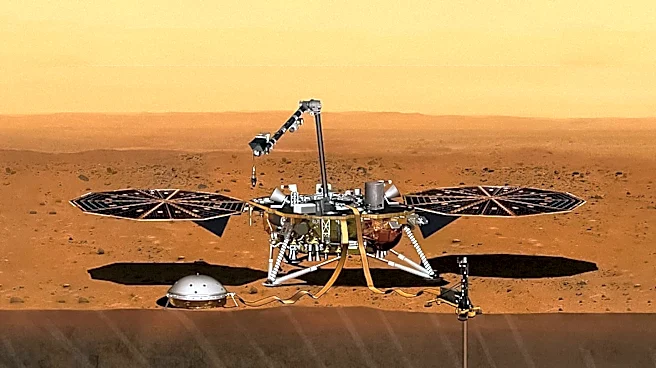
Future missions to Mars may focus on exploring the subsurface to search for signs of life. The European Space Agency's Rosalind Franklin rover, set to launch in 2028, aims to drill up to two meters below the surface to collect samples. This mission could provide valuable data on the potential habitats and biosignatures in Mars' subsurface. Researchers will continue to study Mars' geology and atmosphere to refine models of potential life-supporting environments. The search for life on Mars remains a priority for space agencies, with ongoing efforts to develop technologies for deeper exploration.
Beyond the Headlines
The study of Mars' subsurface highlights the complexity of searching for life on other planets. The potential for life underground challenges traditional exploration methods, requiring advanced technologies and strategies. The findings underscore the importance of interdisciplinary research, combining geology, astrobiology, and planetary science to understand Mars' history and potential for life. The study also raises ethical considerations regarding contamination, as future missions must ensure that samples are not compromised by Earth-based microbes.