
What's Happening?
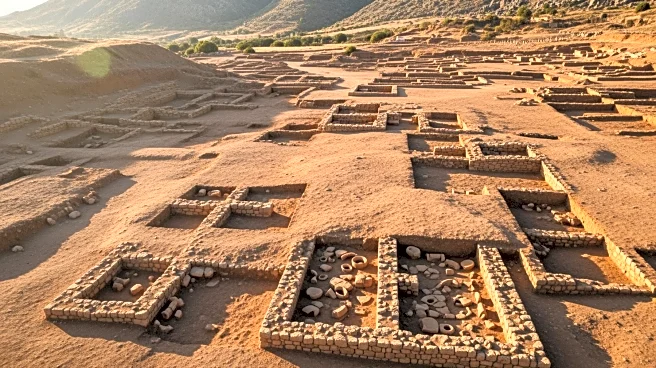
Archaeologists have uncovered 483 ancient settlements in western Turkey, revealing a previously overlooked Bronze Age culture known as the Luwians. These settlements, dating back to between 2000 and 1300
BCE, were found in the region historically known as Asia Minor or Anatolia. The discovery, detailed in a study published in Nature Scientific Data, suggests that the Luwians were a distinct culture, separate from the neighboring Mycenaean Greeks and Hittite Anatolians. The research team, comprising archaeologists, geologists, and geodata specialists, found that the Luwians had their own unique languages, customs, and social structures. The settlements were strategically located on elevated ground, often on hilltops, providing defense and control over surrounding areas. This strategic placement, along with access to natural harbors, indicates that maritime trade was central to the Luwian economy.
Why It's Important?
The discovery of the Luwian settlements is significant as it challenges long-standing historical narratives about the region's ancient history. Previously, much of the history of western Anatolia was told through the perspective of the Hittites, with the Luwians largely ignored. This new evidence suggests that the Luwians played a more prominent role in the region than previously thought. Understanding the Luwians could provide insights into the collapse of the Hittite kingdom, the identity of the Sea Peoples, and the historical context of the Trojan War. The findings offer a new perspective on Mediterranean archaeology and could reshape debates about ancient history in the region.
What's Next?
The findings have been made available to the public through a digital catalog called LuwianSiteMap, allowing scholars and the general public to explore the settlements in detail. This resource opens up the study area to wider exploration and provides an unprecedented opportunity to delve into the rich history of the Luwian culture. As researchers continue to analyze the data, further insights into the Luwians' role in ancient history are expected to emerge, potentially resolving some of the puzzles that have long challenged Mediterranean archaeology.