




What's Happening?
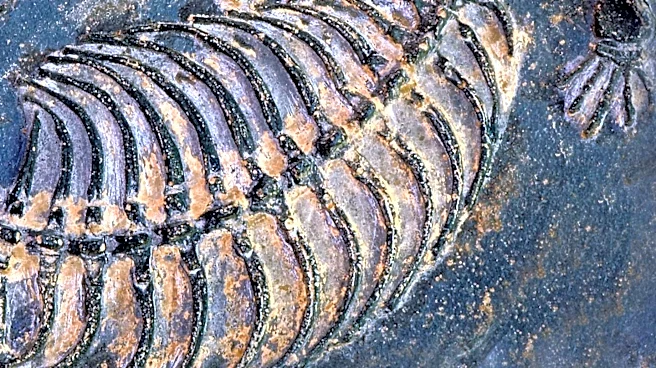
Paleontologists, led by Ross Anderson from the University of Oxford, are investigating Earth's oldest eukaryotic fossils to understand the rise of complex life and its implications for astrobiology. Eukaryotes, which emerged around 1.7 billion years ago,
are considered Earth's first complex organisms, possessing a cell nucleus and organelles like mitochondria. These organisms paved the way for multicellular life, including animals, plants, and fungi. The research focuses on the Ediacaran/Cambrian transition, a period 540 million years ago marked by significant evolutionary developments. Anderson's team is particularly interested in remote areas, such as the islands near Svalbard, Norway, where ancient eukaryotic microfossils might be preserved. The study aims to uncover how life transitioned from single-celled to multicellular forms, a process that occurred multiple times across different regions of Earth.
Why It's Important?
This research is crucial for understanding the origins of complex life on Earth and has significant implications for the search for life beyond our planet. By studying eukaryotic fossils, scientists can gain insights into the conditions that allowed complex life to thrive, which can inform the search for similar conditions on other planets. The findings could reshape evolutionary history and enhance our understanding of astrobiology. The study also highlights the challenges of preserving and identifying ancient fossils, as eukaryotic microfossils are often subject to degradation over billions of years. This research underscores the importance of interdisciplinary approaches, combining paleontology, chemistry, and geology, to uncover the history of life on Earth.
What's Next?
Future research will likely focus on identifying more sites with potential eukaryotic fossils and refining techniques for detecting and analyzing these ancient remains. Collaboration with local communities and advancements in remote sensing technology could enhance the discovery of new fossil sites. Additionally, the study's findings may guide astrobiologists in identifying promising locations for life on other planets, particularly those with conditions similar to early Earth. Continued exploration of Earth's ancient life forms will contribute to a deeper understanding of life's resilience and adaptability, both on our planet and potentially elsewhere in the universe.