






What's Happening?
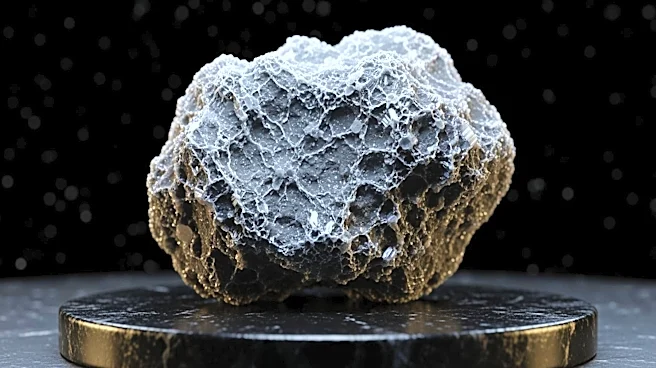
A recent study published in Nature Astronomy reveals that samples from the asteroid Ryugu contain all five nucleobases, the chemical 'letters' that make up DNA and RNA. This discovery supports the hypothesis that the chemical origins of life were present
in the solar system's early formation. The Japan Aerospace Exploration Agency's Hayabusa2 spacecraft collected the samples, which were found to contain nucleobases in roughly equal quantities. This finding suggests that prebiological molecules were common in the solar nebula, potentially seeding early Earth with the ingredients for life.
Why It's Important?
The presence of nucleobases in asteroid Ryugu strengthens the theory that life's building blocks were delivered to Earth from space. This discovery has significant implications for our understanding of the origins of life and the potential for life elsewhere in the universe. It suggests that the components necessary for life could be widespread in the cosmos, providing a new perspective on astrobiology and the search for extraterrestrial life.
What's Next?
Further analysis of the Ryugu samples and comparison with other asteroids and meteorites will continue to shed light on the distribution of life's building blocks in the solar system. Researchers will also explore the implications of these findings for the development of life on Earth and the potential for life on other planets. The study may inspire new missions to collect samples from other celestial bodies, expanding our understanding of the universe's chemical diversity.