




What's Happening?
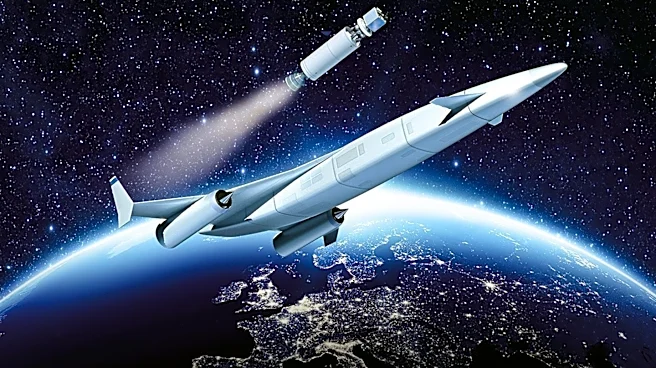
Pan-European missile manufacturer MBDA and German startup Atmos Space Cargo have announced a partnership to study the feasibility and development of deploying deep-strike weapons from Earth orbit using reentry vehicles. The collaboration aims to combine
military payloads with orbital transport and reentry technologies to create a precision orbital deep strike capability. Initially, the focus will be on system architecture, technical feasibility, payload integration, and potential technology demonstrations. Atmos CEO Sebastian Klaus has advocated for Europe to develop an orbital deterrent to address a perceived gap in deep precision strike capabilities, envisioning a conventional system capable of striking any legitimate military target globally within 60 minutes from orbit. MBDA will contribute its expertise in defense systems and military payloads, while Atmos will provide its knowledge in orbital transportation and reentry technology.
Why It's Important?
This partnership signifies a potential shift in defense strategy, exploring the integration of space technology into conventional strike capabilities. The development of a precision orbital deep strike system could significantly enhance a nation's ability to project power and deter aggression by offering rapid, global strike options. For Europe, this initiative aims to strengthen its conventional deterrence and provide a sovereign capability, reducing reliance on other powers for such advanced military assets. The concept of deploying weapons from orbit raises complex questions regarding international space law, arms control treaties, and the potential for an arms race in space. The feasibility study will be critical in determining the technical and operational viability, as well as the strategic implications, of such a system.
What's Next?
The initial phase of the cooperation agreement will concentrate on detailed assessments of system architecture, technical feasibility, and payload integration. This will likely involve extensive research and development to overcome the significant engineering challenges associated with orbital deployment and precise reentry of strike weapons. Any future deployment and operational use of such a system would be subject to applicable international laws and decisions by governmental and military authorities. The companies will also need to navigate the political and ethical landscape surrounding space weaponization. Further specific developments and projects will require additional evaluation and separate agreements, indicating a phased approach to this ambitious undertaking.
Beyond the Headlines
The exploration of space-based strike weapons carries profound implications for global security and the future of warfare. It blurs the lines between conventional and space warfare, potentially leading to new doctrines and strategies. The concept raises significant ethical concerns about the weaponization of space and the potential for unintended escalation in conflicts. Legally, it challenges existing frameworks for the peaceful use of outer space, prompting discussions on whether current treaties adequately address such capabilities. Environmentally, the increased launch activity and potential for debris from such systems could exacerbate orbital congestion. This initiative could also spur other nations to accelerate their own space-based military programs, leading to a more militarized outer space domain and increasing the complexity of international relations.