



What's Happening?
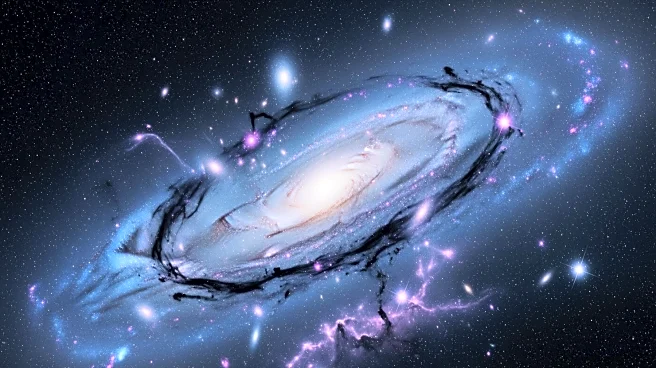
Scientists have observed the largest-known rotating structure in the universe, a filament composed of hundreds of galaxies, gas, and dark matter. This structure, part of the cosmic web, measures about 50 million light-years long and 117,000 light-years wide.
Detected using the MeerKAT radio telescope in South Africa, the filament is located approximately 140 million light-years from Earth. The discovery provides new insights into the large-scale structure of the universe and the role of dark matter in cosmic formations.
Why It's Important?
The detection of this massive rotating filament enhances understanding of the cosmic web, the large-scale structure of the universe. It highlights the role of dark matter in shaping cosmic formations and provides a new perspective on the distribution of galaxies and matter in the universe. This discovery could lead to advancements in cosmology and the study of dark matter, offering clues about the universe's evolution and the forces that govern its structure.
What's Next?
Further research will focus on exploring other potential rotating structures within the cosmic web and understanding their formation and dynamics. As technology and observational techniques improve, scientists hope to detect more such structures and refine models of the universe's large-scale architecture. This ongoing research will contribute to a deeper understanding of the universe's composition and the fundamental forces at play.