



What's Happening?
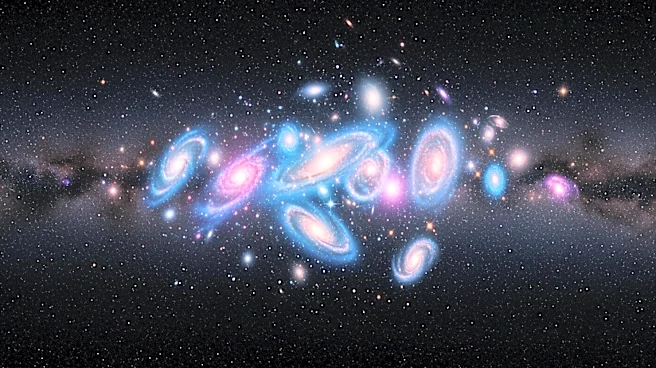
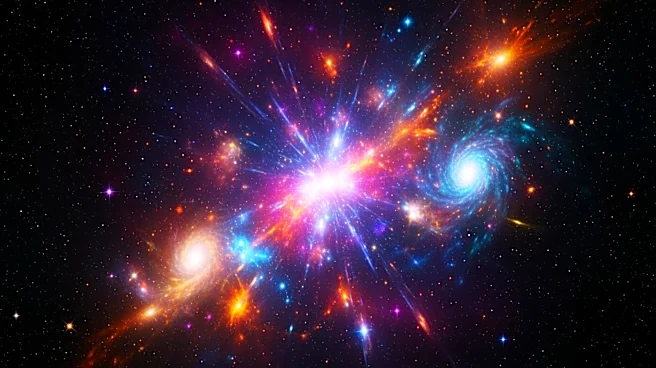
Astronomers have successfully mapped the Vela Supercluster, a massive galactic structure that has been largely obscured from view due to its location behind the Milky Way's 'Zone of Avoidance'. This supercluster, discovered a decade ago, is composed of at least
20 galaxy clusters, each containing hundreds or thousands of galaxies. The Vela Supercluster spans approximately 300 million light-years and contains mass equivalent to about 30 quadrillion suns. The mapping was achieved by measuring the movements of galaxies within and around the supercluster's edge, revealing its immense size and mass. The study, which utilized data from South Africa's MeerKAT telescope, highlights the supercluster's two cores moving towards each other, indicating a coherent large-scale structure.
Why It's Important?
The mapping of the Vela Supercluster is significant as it enhances our understanding of the universe's largest structures. This discovery provides crucial data for astronomers to test and refine cosmological models. The Vela Supercluster's size and mass make it comparable to some of the largest known superclusters, such as Laniakea and Shapley. Understanding these massive structures helps scientists comprehend the distribution of matter in the universe and the forces shaping cosmic evolution. The findings also demonstrate the capabilities of modern telescopes like MeerKAT in penetrating dense regions of space, offering new insights into previously hidden cosmic phenomena.
What's Next?
Future research may focus on creating more detailed maps of the Vela Supercluster using advanced radio telescopes. While current observations have provided significant insights, some parts of the supercluster remain obscured due to the lack of hydrogen in certain galaxies. Continued exploration could lead to a more comprehensive understanding of the supercluster's dynamics and its role in the broader cosmic landscape. Additionally, these findings may prompt further studies into other hidden structures within the 'Zone of Avoidance', potentially unveiling more about the universe's hidden architecture.
Beyond the Headlines
The discovery of the Vela Supercluster underscores the challenges and opportunities in astronomical research. The ability to map such a massive structure despite its obscured location highlights the advancements in observational technology and techniques. This achievement also raises questions about the potential existence of other large-scale structures hidden by the Milky Way, suggesting that our understanding of the universe's composition is still evolving. The study's success may inspire further investment in radio astronomy and international collaborations to explore the universe's most elusive regions.