
What's Happening?
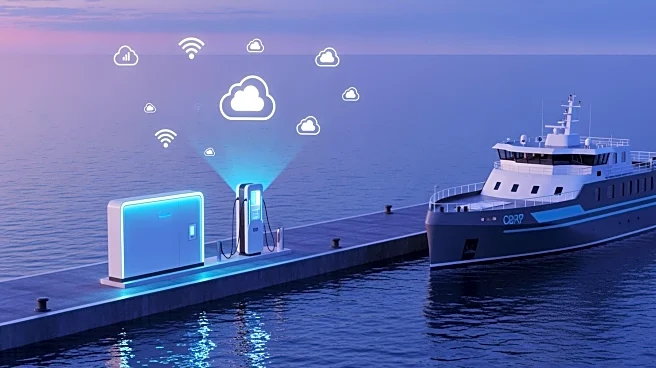
CATL, the world's largest battery company, is making significant strides in maritime electrification through its marine subsidiary, Contemporary Amperex Electric Vessel (CAEV). The company unveiled its Ship-Shore-Cloud
electric vessel solution at Marintec China 2025, marking a shift from pilot exercises to operating infrastructure. CATL's systems are already powering approximately 900 ships, demonstrating the practicality of electrification in maritime transport. The solution integrates batteries, power electronics, propulsion, and control systems onboard, while providing charging and battery swapping infrastructure onshore. This approach reduces operational risk and lifecycle costs, positioning CATL as a leader in maritime electrification.
Why It's Important?
The advancement of CATL's maritime electrification strategy is crucial for reducing emissions and operational costs in the shipping industry. By integrating systems across ships, ports, and operations, CATL is setting a new standard for maritime transport. This development aligns with China's national policy objectives of peaking emissions before 2030 and achieving carbon neutrality by 2060. The strategic partnership with A.P. Moller Maersk further strengthens CATL's position, as it embeds its technology into global logistics and supply chains. This move not only benefits Maersk by decarbonizing assets but also reinforces CATL's role as a platform provider in maritime electrification.
What's Next?
CATL's partnership with Maersk is expected to accelerate the electrification of ports and shipping globally. As ports become energy hubs, the pressure on deep-sea shipping eases, allowing for more sustainable practices. The focus will likely shift towards electrifying inland shipping, ports, and short sea routes, where emissions have the greatest impact on nearby communities. This trajectory suggests a gradual decarbonization of maritime activities, with CATL leading the charge in integrating battery technology into the sector.
Beyond the Headlines
CATL's strategy highlights the importance of integrated systems in maritime electrification. By reducing coordination failures and operational risks, CATL is paving the way for a more sustainable shipping industry. The company's approach also underscores the need for policy alignment with industrial reality, as seen in China's supportive environment for electrification. This contrasts with the United States, where policy has hindered progress in maritime decarbonization, highlighting the global disparities in addressing climate change.