







What's Happening?
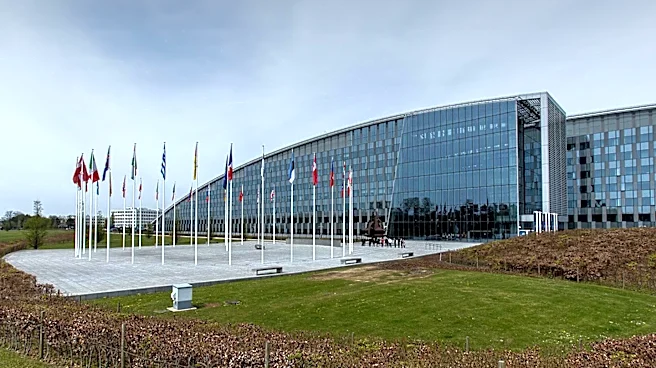
NATO is actively seeking alliance-wide military space contributions, aiming to integrate space and counterspace capabilities into its defense arsenal. This initiative marks a significant shift from traditional commitments based on aircraft and tanks,
as more NATO members are developing and openly discussing their space systems. The impetus for this push comes from a perceived threat from rivals, particularly China and Russia, who are believed to be conducting nefarious operations in space. Brig. Gen. David Morpurgo, assistant chief of staff for force development for the alliance, stated that NATO is changing its mindset to produce effects in space as a warfighting domain. Air Chief Marshal Johnny Stringer, deputy supreme allied commander for Europe, announced that NATO's Defense Planning Process (NDPP) will now include capability targets for space, a move he described as "long overdue."
Why It's Important?
This strategic pivot by NATO is crucial for the U.S. and its allies as it acknowledges space as a critical domain for modern warfare and deterrence. The integration of space capabilities into NATO's defense planning will enhance the alliance's ability to monitor, communicate, and respond to threats, thereby strengthening collective security. For the U.S. defense industry, this could open new avenues for collaboration and contracts, as European allies seek to acquire advanced space technologies and services. It also underscores the growing importance of space in national security strategies, potentially leading to increased investment in space-based assets and counterspace technologies across NATO members. The move aims to counter the perceived advantages of adversaries in space, ensuring that NATO maintains a technological edge and deterrence capability in this rapidly evolving domain.
What's Next?
The political guidance to kick off the new Defense Planning Process (NDPP) with space capability targets is expected in February. While the actual capability targets are not due for another two years, Air Chief Marshal Johnny Stringer is pushing for mechanisms to credit member states for early commitments. NATO also plans to address challenges such as the highly classified nature of many space capabilities and differing levels of maturity among member states. The alliance will likely encourage countries without their own systems to contribute through commercial services like communications or Earth imaging. Furthermore, NATO aims to increase its space staffing, particularly at the Space Operations Center in Ramstein, Germany, to accelerate the maturation of its space activities.
Beyond the Headlines
The deeper implications of NATO's focus on space extend to the ethical and legal frameworks governing military activities in orbit. As space becomes a contested domain, questions arise about the definition of aggression in space, the rules of engagement, and the potential for an arms race in orbit. This shift could also accelerate the development of dual-use technologies, blurring the lines between civilian and military space applications. Culturally, it signifies a growing recognition of space as an integral part of national and international security, moving beyond its traditional perception as solely a scientific or commercial frontier. The long-term shift could lead to a more militarized space environment, necessitating new international treaties and norms to prevent conflict and ensure the peaceful use of outer space.