



What's Happening?
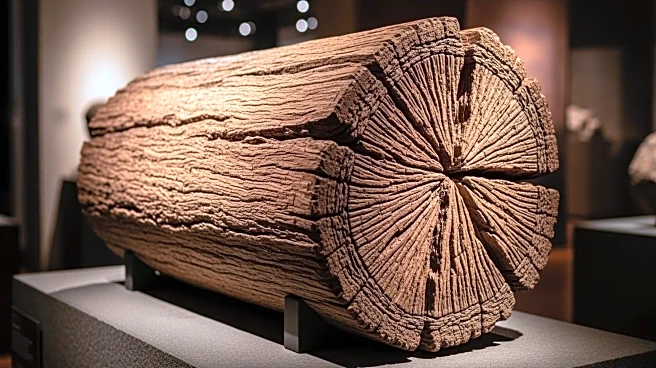
A fossil of Prototaxites, a colossal organism that once dominated ancient landscapes, is now on display at the National Museum of Scotland. Initially thought to be a fungus, recent studies suggest that Prototaxites, which grew over eight meters tall and vanished
around 360 million years ago, belonged to an entirely extinct evolutionary branch. The 410-million-year-old fossil was discovered in the Rhynie chert, a sedimentary deposit in Aberdeenshire, Scotland. This discovery has been added to the museum's collection, highlighting Scotland's significant role in the history of natural sciences. Dr. Sandy Hetherington, a co-lead author of the study, emphasized the unique anatomical and chemical characteristics of Prototaxites, which distinguish it from known plant or fungal life. The research, published in Science Advances, underscores the importance of museum collections in advancing scientific understanding.
Why It's Important?
The discovery and study of Prototaxites provide crucial insights into the diversity of life during the Cambrian period, challenging previous classifications and expanding our understanding of evolutionary history. This finding highlights the potential for museum collections to contribute to cutting-edge research, offering new perspectives on ancient life forms. The research underscores the value of interdisciplinary collaboration, combining paleontology, biology, and advanced technologies to explore the complexities of early life on Earth. By revealing an entirely extinct branch of life, this study not only enriches our knowledge of the past but also informs current scientific debates about the evolution of complex organisms.