
What's Happening?
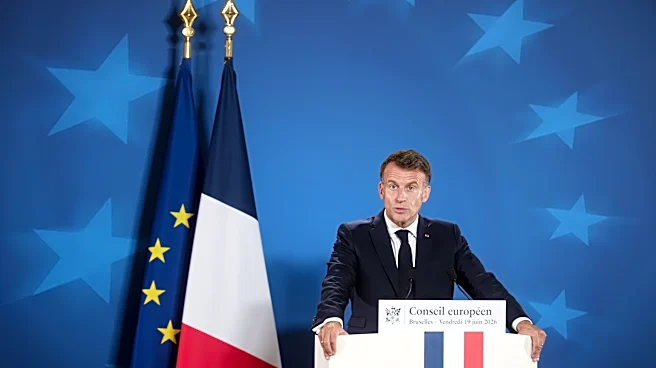
Armenian Prime Minister Nikol Pashinyan met with French President Emmanuel Macron at the Élysée Palace in Paris on November 10 during a working visit to France. The meeting, which took place during Pashinyan's participation in the ninth Paris Peace Forum,
focused on strengthening the Armenian-French strategic partnership. Both leaders expressed satisfaction with the strong bilateral relations and discussed expanding cooperation across various sectors, including joint infrastructure projects. A significant part of their discussion also revolved around the development of Armenia-European Union relations, with a particular emphasis on progress towards visa liberalization and the implementation of EU-supported reforms. Additionally, they exchanged views on regional developments and ongoing political processes, following broader discussions on the EU's role in the South Caucasus held in Yerevan on November 6.
Why It's Important?
This meeting is important for the U.S. as it highlights the growing strategic alignment between Armenia and European powers, particularly France, amidst complex geopolitical dynamics in the South Caucasus. Increased cooperation between Armenia and the EU, especially on visa liberalization and reforms, could strengthen democratic institutions and economic ties, contributing to regional stability. For the US, a stable and democratic South Caucasus is crucial for energy security, counter-terrorism efforts, and maintaining a balance of power in a region bordering Russia, Turkey, and Iran. France's active role in supporting Armenia could also be seen as a counterweight to other regional influences, potentially impacting the broader geopolitical landscape. The discussions on regional developments are particularly relevant given the ongoing Armenia-Azerbaijan peace process, where the EU's involvement, as noted by EU Special Representative Magdalena Grono, is seen as critical for practical initiatives towards normalization.
What's Next?
Following the meeting, the focus will be on the implementation of the discussed cooperation initiatives, particularly in infrastructure and other sectors. Progress on Armenia-European Union relations, including visa liberalization and EU-supported reforms, will be closely monitored. The discussions on regional developments suggest continued diplomatic engagement regarding the Armenia-Azerbaijan peace process. EU Special Representative Magdalena Grono emphasized that conflict resolution remains primarily driven by Armenia and Azerbaijan, but the EU can support practical initiatives. Specific areas for potential progress include border delimitation, trade, and transport connectivity. The next edition of the forum, which discussed the EU's role in the South Caucasus, is scheduled to take place in Tbilisi in early 2027, indicating ongoing regional dialogue and engagement.
Beyond the Headlines
This meeting signifies Armenia's strategic pivot towards closer ties with Europe, potentially diversifying its foreign policy and security alignments. Historically, Armenia has had strong ties with Russia, but recent geopolitical shifts and conflicts in the South Caucasus have prompted a re-evaluation of its international partnerships. France, with its significant Armenian diaspora and historical connections, is emerging as a key European ally. This shift could have long-term implications for regional power dynamics, potentially reducing Russia's influence and increasing the EU's footprint in the South Caucasus. The emphasis on visa liberalization and reforms also points to a deeper integration of Armenia into European norms and standards, which could foster democratic development and economic growth, aligning with broader Western strategic interests in the region.