
What's Happening?
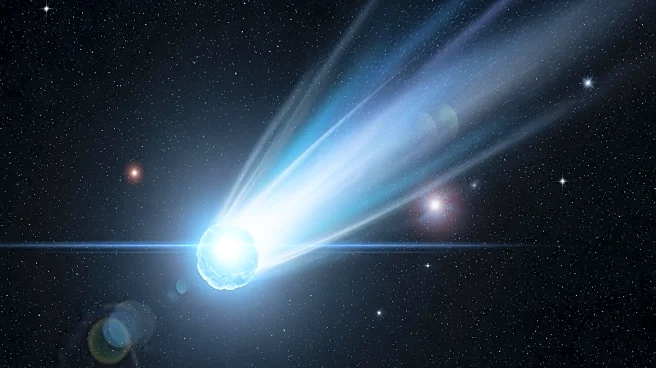
Interstellar comet 3I/ATLAS, the third known visitor from another star system, is drawing significant attention from astronomers worldwide. Recent observations from the Hubble Space Telescope and other spacecraft
have provided new insights into the comet's composition and trajectory. The comet, first spotted in July 2025, is on a hyperbolic path, indicating its origin outside our solar system. Key observations include a teardrop-shaped coma and an 'anti-tail' extending toward the Sun. The comet's nucleus is estimated to be between 440 meters and 5.6 kilometers wide, potentially larger than previous interstellar comets.
Why It's Important?
3I/ATLAS offers a rare opportunity to study the chemistry of another planetary system without leaving Earth. The comet's unusual characteristics, such as its metal-rich composition and potential cryovolcanism, provide valuable data on the diversity of celestial bodies in the galaxy. These findings could enhance our understanding of planet formation and the potential for life in other star systems. The coordinated global observation campaign also serves as a test for planetary defense strategies, improving our ability to track and analyze interstellar objects.
What's Next?
Astronomers will continue to monitor 3I/ATLAS as it approaches its closest point to Earth on December 19, 2025. Ongoing observations from Hubble, the James Webb Space Telescope, and other instruments will refine estimates of the comet's size, mass, and composition. The data collected will contribute to future missions designed to intercept and study interstellar objects. As the comet exits the inner solar system, researchers will analyze the extensive dataset to uncover more about its origins and the processes shaping its behavior.