







What's Happening?
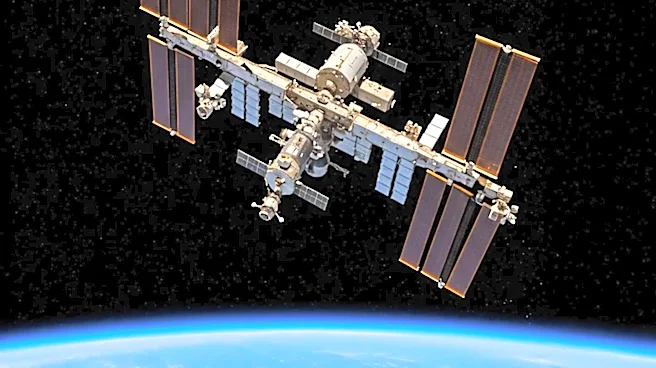
NASA has commenced a series of scientific studies aboard the International Space Station (ISS) focusing on cartilage engineering and blood pressure research. The Expedition 74 crew, including NASA flight engineers Jessica Meir and Jack Hathaway, are conducting
experiments in the Kibo laboratory module. They are processing cartilage cell samples in microgravity to understand how to repair and regenerate injured cartilage on Earth. Additionally, Roscosmos cosmonauts Sergey Kud-Sverchkov and Sergei Mikaev are studying the effects of weightlessness on blood flow and the respiratory system. These studies aim to advance human health both on Earth and in space, with potential applications for long-term space missions.
Why It's Important?
The research being conducted on the ISS is crucial for developing medical techniques that could benefit both astronauts and people on Earth. Understanding cartilage regeneration in microgravity could lead to breakthroughs in treating joint injuries and degenerative diseases. Moreover, the blood pressure studies could provide insights into cardiovascular health in space, which is vital for the safety of astronauts on extended missions. These findings could also translate into better health management strategies for people on Earth, particularly in understanding how different environments affect human physiology.
What's Next?
The results from these experiments will be analyzed once the samples return to Earth, potentially leading to new medical treatments and fitness techniques for astronauts. The ISS crew will continue to conduct various scientific experiments and maintain the station's equipment. Future missions may build on these findings to enhance the safety and health of astronauts on long-duration spaceflights, such as missions to Mars.