






What's Happening?
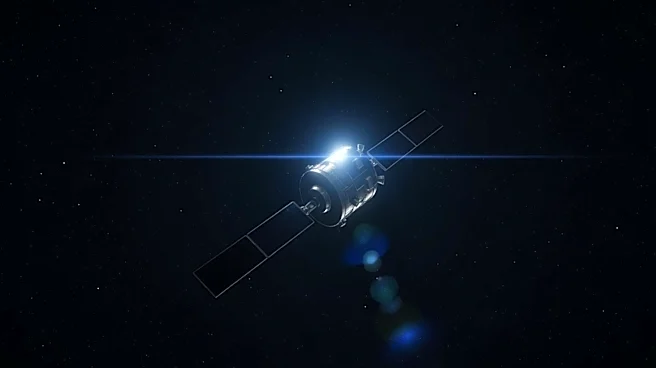
NASA's Parker Solar Probe has been conducting a series of close passes through the Sun's corona, the outer atmosphere where temperatures exceed a million degrees Celsius. This mission aims to solve the long-standing mystery of why the corona is significantly
hotter than the Sun's surface below. The probe, which has come within 6.1 million kilometers of the Sun, is equipped with a carbon-composite shield to withstand extreme temperatures while collecting data on plasma density, temperature, and magnetic fields. The mission has identified phenomena such as 'switchbacks' in the solar wind, which may contribute to both heating the corona and accelerating the solar wind.
Why It's Important?
The Parker Solar Probe's findings are crucial for understanding solar physics, particularly the mechanisms that heat the Sun's corona. This knowledge could have broader implications for predicting solar weather, which affects satellite operations, communications, and power grids on Earth. The mission's data could help distinguish between competing theories of wave heating and magnetic reconnection as the primary source of coronal heating. Understanding these processes is vital for improving models of solar activity and its impact on the solar system.
What's Next?
The Parker Solar Probe will continue its mission, making repeated passes through the Sun's corona to gather more data. The focus will be on distinguishing between the wave heating and magnetic reconnection theories. The mission's next phase, beyond late 2026, is under NASA review, with the potential to provide further insights into solar dynamics during the Sun's active phase.