









What's Happening?
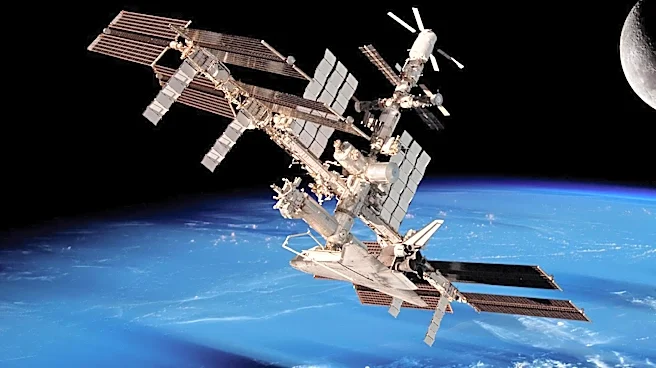
NASA astronaut Anil Menon, along with Russian cosmonauts Pyotr Dubrov and Anna Kikina, successfully launched to the International Space Station (ISS) aboard a Russian Soyuz rocket. The launch took place from Baikonur Cosmodrome in Kazakhstan at 10:47
a.m. EDT. The spacecraft reached the ISS after just two orbits, docking at 1:52 p.m. EDT while flying 260 miles above the Mediterranean Sea. This mission marks a continuation of international collaboration in space exploration, with the crew joining the current ISS residents to conduct various scientific experiments and maintenance tasks.
Why It's Important?
The successful launch and docking of the Soyuz spacecraft underscore the ongoing international cooperation in space exploration, particularly between NASA and Roscosmos. This collaboration is crucial for the continued operation and scientific output of the ISS, which serves as a unique platform for research in microgravity. The mission also highlights the importance of maintaining diplomatic and scientific ties between the U.S. and Russia, even amidst geopolitical tensions. The presence of international crews on the ISS facilitates a diverse range of scientific research that benefits multiple countries and advances our understanding of space.
What's Next?
The crew will spend several months aboard the ISS, conducting experiments and performing maintenance tasks. Their work will contribute to ongoing research in areas such as biology, physics, and materials science. The mission also sets the stage for future international collaborations in space exploration, including potential joint missions to the Moon and Mars. As space agencies around the world continue to plan for more ambitious missions, the success of this launch reinforces the value of international partnerships in achieving complex space exploration goals.