





What's Happening?
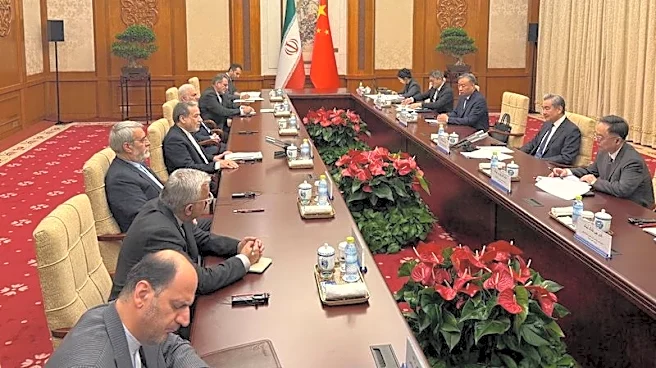
President Trump has announced that Iran's enriched uranium will be transferred to the United States as part of an emerging agreement between Washington and Tehran. This development comes as Israeli officials have been briefed on the talks, indicating
optimism for a potential deal. The agreement, which is not yet finalized, involves Iran agreeing to halt uranium enrichment for 15 years and to restore inspections by the International Atomic Energy Agency. The deal also includes discussions on limiting ballistic missile ranges, although the final wording is still under negotiation. The agreement aims to address concerns over Iran's nuclear capabilities and its support for proxies like the Houthis in Yemen and Hezbollah in Lebanon.
Why It's Important?
The potential agreement between the U.S. and Iran is significant as it addresses longstanding concerns over Iran's nuclear program and its regional influence. By transferring enriched uranium to the U.S. and halting enrichment, the deal could reduce nuclear proliferation risks. It also has implications for regional stability, particularly in the Middle East, where Iran's support for proxy groups has been a source of tension. The deal could lead to the easing of some sanctions on Iran, potentially impacting global oil markets and economic relations. However, the agreement's success depends on acceptance by Iran's leadership and the Islamic Revolutionary Guard Corps.
What's Next?
The next steps involve finalizing the agreement's details and securing approval from Iran's Supreme Leader and other key stakeholders. The U.S. and Iran are expected to continue negotiations, with Iran providing an official response within 48 hours. The outcome of these talks could influence U.S.-Iran relations and broader geopolitical dynamics in the region. Additionally, Israel's response and its coordination with the U.S. will be crucial, as it has been closely monitoring the situation and preparing for potential scenarios.