





What's Happening?
The World Bank is emphasizing the critical need for accelerated progress in the fight against financial crime, particularly in low-income countries. An estimated $1-$1.5 trillion is laundered through the global financial system annually, with illicit
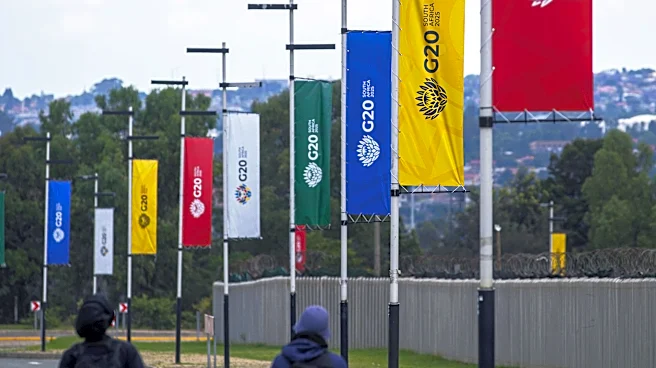
financial flows draining approximately $88 billion from Africa alone each year. This loss significantly impacts public budgets, diverting funds from essential infrastructure like schools, hospitals, and roads, and eroding trust in institutions. The Financial Action Task Force (FATF), the global anti-money laundering watchdog, has established international standards to combat these flows, but progress in low-capacity countries has been limited, with 84 percent of anti-money laundering and counter-terrorist financing (AML/CFT) outcomes rated as having low effectiveness in the least developed countries. The FATF, in collaboration with the World Bank Group and South Africa, has launched a new approach to support these countries, focusing on tailored assessments and longer-term support.
Why It's Important?
The slow progress in combating financial crime in low-income countries has profound implications for global development and stability. For the U.S., this issue is important because illicit financial flows can fuel instability and conflict in fragile regions, potentially leading to humanitarian crises and security challenges that require international intervention. Furthermore, these flows can be linked to transnational criminal organizations, impacting global financial integrity and potentially affecting U.S. economic interests. The diversion of funds from critical development projects in these nations can hinder their economic growth, creating environments ripe for extremism and migration pressures. By supporting efforts to strengthen AML/CFT capacities in low-income countries, the U.S. can contribute to global stability, foster more transparent financial systems, and protect its own economic and security interests by reducing the avenues for illicit finance.
What's Next?
The new approach launched by the FATF, with leadership from the World Bank Group and South Africa, will introduce several changes to accelerate progress. This includes a more tailored assessment of AML/CFT effectiveness in low-capacity countries, focusing on high-risk areas and providing a refined list of key recommended actions. The assessments will also give greater recognition to country context, integrating AML/CFT efforts with wider national priorities such as financial inclusion and domestic revenue mobilization. Crucially, the new approach will provide longer-term support to the lowest capacity countries after evaluations conclude, recognizing that reform agendas often take longer to implement. The FATF’s Global network will increase dialogue among technical assistance providers, donors, and least developed countries to address priority needs for support, with the World Bank playing a key role in these discussions. This sustained focus aims to maintain political leadership and buy-in for these reforms.
Beyond the Headlines
The World Bank's emphasis on financial crime in low-income countries highlights a deeper systemic challenge: the disproportionate impact of illicit financial flows on the most vulnerable economies. This issue extends beyond mere financial loss, touching upon governance, human rights, and the very fabric of democratic institutions. The difficulty in detecting illicit flows in economies with large informal sectors and under-resourced agencies points to the need for comprehensive, multi-faceted solutions that address not only financial regulations but also broader institutional capacity building and public awareness. The reframing of AML/CFT from a compliance requirement to a national security and development priority, as seen in countries like Namibia and Senegal, signifies a crucial shift in perspective. This suggests that effective anti-corruption efforts require strong political will and a holistic approach that integrates financial integrity with national development goals, fostering trust and stability.