







What's Happening?
Russia has opened a photo exhibition at its embassy in Washington, D.C., titled 'Crimean Gold: 'Civilized' Europe Robs Russian Treasures.' The exhibition, prepared by the Russian Military Historical Society, promotes Russia's claim that the collection
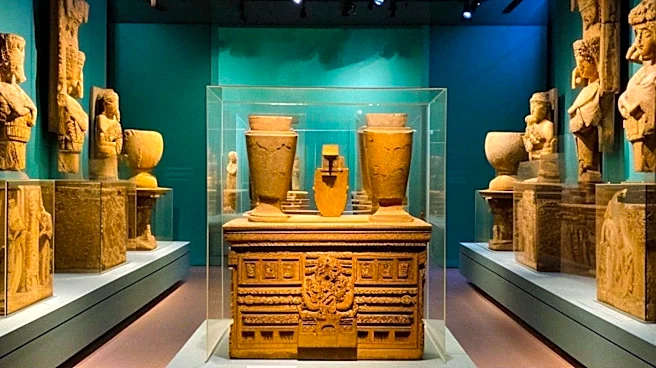
of archaeological artifacts known as 'Scythian gold' belongs to Russia. According to Russian state media TASS, the exhibition asserts that these artifacts are part of the collections of four museums in Crimea and accuses Ukraine of unlawfully retaining them. The collection was originally sent to the Allard Pierson Museum in Amsterdam in 2013 for an exhibition. Following Russia's occupation of Crimea, Moscow demanded the artifacts' return to Russia. However, in 2023, the Supreme Court of the Netherlands ruled that the collection should be transferred to Ukraine, determining that the artifacts are part of Ukraine's state Museum Fund and do not belong to museums in Russian-occupied Crimea.
Why It's Important?
This exhibition represents a continued effort by Russia to assert its claims over Ukrainian cultural heritage, particularly artifacts from Crimea. By presenting these claims in Washington, Russia aims to influence international perception and legitimize its annexation of Crimea through cultural narratives. The dispute over the 'Scythian gold' highlights broader concerns about the fate of Ukrainian cultural heritage under Russian occupation, with reports indicating that Russia has unlawfully removed numerous cultural artifacts from Crimea. The exhibition also serves as a counter-narrative to international legal decisions, such as the Dutch Supreme Court's ruling, which affirmed Ukraine's ownership of the artifacts. This cultural appropriation can be seen as part of a wider strategy to erase Ukrainian identity and history in occupied territories, making the preservation and rightful ownership of these artifacts a significant point of contention in the ongoing conflict.
What's Next?
The exhibition in Washington is likely to draw criticism from Ukraine and its international allies, who will continue to advocate for the return of the 'Scythian gold' and other cultural artifacts to Ukraine. Russia is expected to persist in its efforts to claim ownership of these artifacts and use cultural diplomacy to support its territorial claims. This could lead to further diplomatic exchanges and legal challenges regarding cultural heritage. Ukraine will likely continue to document and report instances of cultural heritage destruction and appropriation in occupied territories, seeking international support for their preservation and restitution. The dispute over the 'Scythian gold' may also serve as a precedent for future cases involving cultural artifacts from conflict zones, emphasizing the importance of international law in protecting cultural heritage.
Beyond the Headlines
The 'Scythian gold' dispute transcends mere ownership of ancient artifacts; it is a battle over cultural identity, historical narrative, and international law. Russia's exhibition in Washington is an attempt to weaponize culture, using historical artifacts to bolster its political agenda and legitimize its actions in Crimea. This practice of cultural appropriation in conflict zones can have long-lasting effects on the identity of affected populations and the historical record. The ongoing destruction and removal of cultural heritage in occupied territories, as reported by Ukraine's Defense Intelligence, represent a systematic effort to erase Ukrainian cultural presence. This raises profound ethical questions about the role of cultural institutions and international bodies in protecting heritage during wartime. The case of the 'Scythian gold' underscores the critical need for robust international frameworks to prevent the looting and misappropriation of cultural property in times of conflict.