




What's Happening?
Randy Hurd, a researcher from Weber State University, is recognized for his contribution to a study on urinal design aimed at significantly reducing splashback. This research, published in PNAS Nexus, earned an Ig Nobel Prize in Physics. The study focused
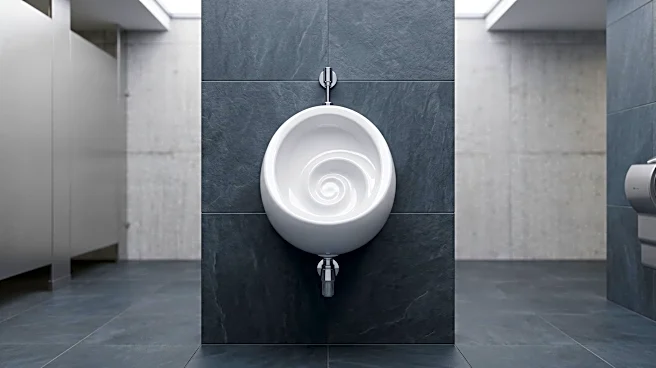
on the 'dynamics of urine' and sought to identify optimal urinal architectures to prevent splashes. Researchers simulated urine jets using computer programs to evaluate splash quantities, considering factors like impact angle, impact speed, surface material, and atmospheric pressure. Their findings indicate that maintaining an impact angle below approximately 30 degrees drastically reduces splashback. The team developed two new urinal models, the Cornucopia and the Nautilus, which are designed to maintain this low impact angle across their surfaces, regardless of the user's aim. The Cornucopia model was found to be the most effective in retaining splashes, while the Nautilus offers greater adaptability for various users, including taller individuals, children, and those in wheelchairs, and is suitable for unstable environments like trains or planes. The study claims these new designs can reduce splashes by nearly 99% compared to conventional urinals.
Why It's Important?
This research, while seemingly unconventional, holds significant implications for public hygiene and facility maintenance. The reduction of urinal splashback directly contributes to cleaner public restrooms, which can enhance public health by minimizing the spread of bacteria and improving overall sanitation. For businesses and public institutions, this innovation could lead to substantial cost savings in cleaning supplies and labor, as less frequent and less intensive cleaning would be required. The improved design also addresses a common discomfort for users, potentially leading to a more positive public experience in shared facilities. Furthermore, the study highlights the practical application of physics and engineering principles to solve everyday problems, demonstrating how scientific inquiry can lead to tangible improvements in infrastructure and public services. The adaptability of designs like the Nautilus also suggests potential benefits for accessibility and user comfort across diverse populations and environments.
What's Next?
The researchers acknowledge that their current study is not definitive and suggest that further work is needed to validate their models, particularly by considering additional factors such as liquid viscosity. This indicates that future research may refine the existing designs or explore new variables to achieve even greater efficiency in splash reduction. Manufacturers of plumbing fixtures and public facility designers may consider incorporating these research findings into future product development and architectural plans. The success of these designs could lead to a new standard for urinal construction, potentially influencing building codes or public health guidelines related to restroom hygiene. Continued collaboration between academic researchers and industry could accelerate the adoption of these improved designs, leading to widespread implementation in public and commercial spaces.
Beyond the Headlines
Beyond the immediate practical benefits, this study underscores a broader cultural and scientific shift towards applying rigorous scientific methods to seemingly mundane aspects of daily life. The Ig Nobel Prize, while often highlighting humorous or unusual research, frequently points to studies that, upon closer examination, reveal significant underlying scientific principles or practical applications. This particular research challenges the long-standing, largely unchanged design of urinals, prompting a re-evaluation of how everyday objects can be optimized through scientific understanding. It also touches upon the often-overlooked aspect of public sanitation and its impact on societal well-being and resource allocation. The study implicitly raises questions about design thinking and innovation in areas traditionally considered static, encouraging a more critical and scientific approach to improving common infrastructure. The focus on user experience and accessibility in the Nautilus design also reflects a growing emphasis on inclusive design in public spaces.