






What's Happening?
Researchers at National Taiwan University (NTU), in a collaborative effort spanning the College of Engineering, College of Medicine, and the National Taiwan University Hospital (NTUH), have introduced a groundbreaking method for producing aerogels. This
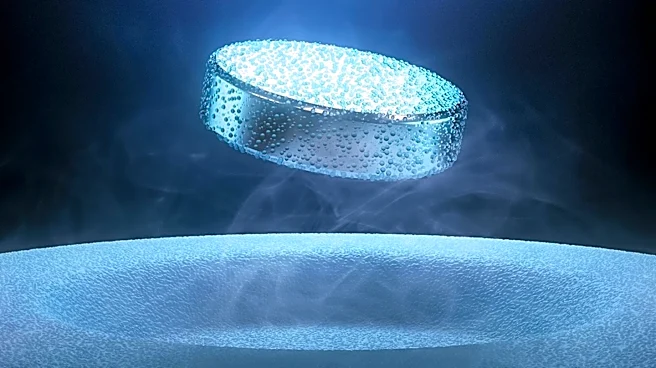
new technique, detailed in Nature Communications, utilizes vapor sublimation and deposition polymerization to create ultralight, highly porous materials directly from solid solutions. Unlike traditional aerogel manufacturing, which relies on liquid-based sol-gel chemistry and complex drying processes, this solvent-free approach transforms frozen solid templates containing microscopic gas bubbles into three-dimensional aerogels under low-pressure conditions. During this process, ice sublimates into vapor while polymer molecules deposit and assemble into an interconnected porous network. This environmentally friendly method avoids harmful byproducts and offers enhanced flexibility in material design. The resulting aerogels boast exceptional properties, including densities as low as 0.004 g/cm³, porosities of 90–99%, and surface areas exceeding 1,300 m²/g, all while maintaining strong mechanical stability. The research team successfully fabricated various types of aerogels, including metal-organic framework (MOF) aerogels, multi-component aerogels, cell-laden aerogels, and gas-laden aerogels, using this single fabrication strategy.
Why It's Important?
This innovative aerogel fabrication platform holds significant implications for various U.S. industries and scientific fields. The ability to produce customizable aerogels with ultralight weight, multifunctionality, and biological compatibility opens new avenues in healthcare, biotechnology, electronics cooling, energy storage, aerospace materials, and environmental engineering. In biomedical applications, the research demonstrated that living stem cells and other cell types remained biologically active within the aerogel structures, supporting stem cell spheroid formation, neural differentiation, angiogenesis, and osteogenesis. This makes the technology highly promising for tissue engineering and regenerative medicine, potentially leading to advancements in medical treatments and therapies. Furthermore, the aerogels' capacity to store and release gases like argon and carbon dioxide in a controlled manner could revolutionize gas delivery, sensing, and environmental remediation efforts, offering solutions for industrial processes and pollution control. The environmentally friendly, solvent-free nature of the fabrication process also aligns with growing demands for sustainable manufacturing practices, potentially reducing the environmental footprint of material production in the U.S.
What's Next?
The development of this gaseous-born aerogel fabrication platform is expected to lead to further research and development in diverse applications. Future steps will likely involve optimizing the fabrication process for large-scale production, which could make these advanced materials more accessible for commercial use. The potential for incorporating a wide range of functional components suggests that researchers will explore new material combinations and functionalities tailored to specific industry needs, such as enhanced thermal insulation for aerospace or more efficient catalysts for energy applications. In the biomedical sector, further studies will focus on in-vivo testing and clinical trials to validate the efficacy and safety of cell-laden aerogels for regenerative medicine. Additionally, the controlled gas storage and release capabilities will likely be investigated for practical applications in gas sensors, drug delivery systems, and advanced filtration technologies. The scalability and versatility of this new method could attract significant investment and collaboration from U.S. companies and research institutions seeking to leverage these advanced materials for next-generation products and solutions.
Beyond the Headlines
Beyond the immediate applications, this research signifies a broader shift in materials science towards more sustainable and precise manufacturing techniques. The elimination of liquid-based chemistry and complex drying processes not only reduces environmental impact but also offers unprecedented control over material architecture at the nanoscale. This level of precision could unlock entirely new material properties and functionalities that were previously unattainable. Ethically, the successful integration of living cells within these aerogels raises important considerations for bioengineering and regenerative medicine, particularly regarding the long-term implications of such advanced tissue constructs. Culturally, the development highlights the increasing interdisciplinary nature of scientific research, with collaboration between engineering, medicine, and hospital sectors driving significant breakthroughs. The potential for these aerogels to address critical global challenges, from climate change (through advanced gas storage) to healthcare (through regenerative therapies), underscores their profound long-term societal impact, potentially reshaping how various industries approach material design and application.