






What's Happening?
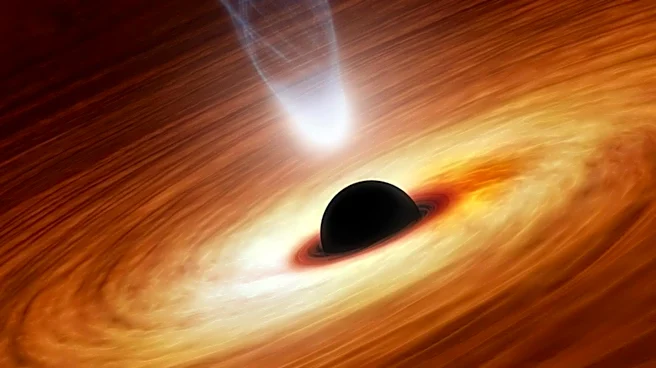
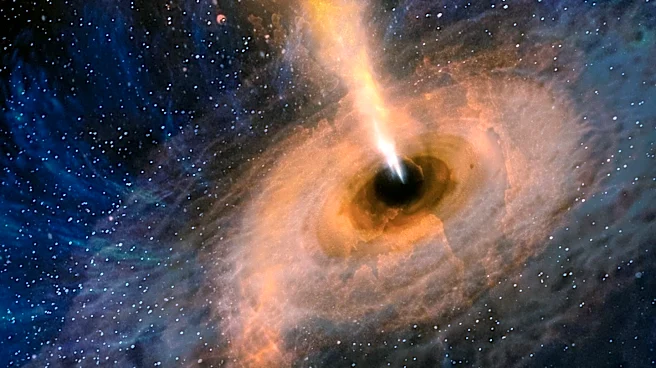
A new study led by astronomers Sanchayeeta Borthakur of Arizona State University (ASU) and Namrata Roy of the Raman Research Institute (RRI) provides evidence that narrow jets of hot plasma, launched by supermassive black holes at the centers of galaxies,
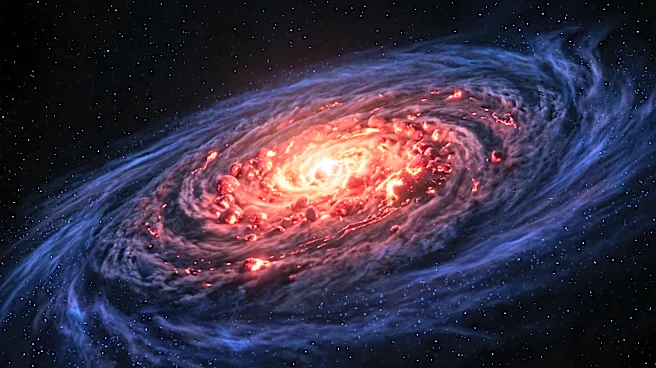
can significantly influence the circumgalactic medium (CGM). The CGM is an enormous reservoir of cold, dense gas surrounding large galaxies, including the Milky Way, which is essential for the formation of new stars. The research, published in the Astrophysical Journal Letters, indicates that these black hole jets disturb this gas reservoir, preventing it from cooling and flowing inward to form stars. By combining observations from hundreds of galaxies using data from the Dark Energy Spectroscopic Instrument (DESI) survey and radio jet measurements from the LOFAR Two-meter Sky Survey (LoTSS), the team found that the jets ionize hydrogen gas along their paths, causing it to glow in H-alpha. This directional glow suggests that the jets act as concentrated beams, altering the gas at tremendous distances from the galactic center.
Why It's Important?
This discovery is crucial for understanding the long-term evolution of galaxies. Previously, astronomers were puzzled as to why galaxies, despite being surrounded by vast amounts of star-forming material in the CGM, do not produce far more stars. The study suggests that black hole jets act as a significant brake on galaxy growth by heating, stirring, and disrupting the gas in the CGM, making it harder for this material to cool and fall back toward the galaxy. Without this incoming supply of cold gas, galaxies have less fuel for creating new stars, potentially pushing them toward a quieter state with much lower levels of star formation. This research highlights how even relatively small supermassive black holes can have an enormous impact on their host galaxies, extending their influence hundreds of thousands of light-years away and ultimately determining a galaxy's future star-forming activity.
What's Next?
The findings open new avenues for exploring the intricate connection between supermassive black holes and galaxy evolution. Astronomers and theorists now have clearer evidence to test how black hole jets interact with galaxies and influence their development. Future research will likely focus on further investigating the mechanisms by which these jets transfer energy across vast cosmic distances and how this energy precisely alters the physical and chemical properties of the CGM. The success of combining large optical and radio surveys, such as DESI and LoTSS, suggests that similar multi-wavelength approaches will be vital in uncovering more hidden patterns in galactic phenomena. This work could lead to a more comprehensive understanding of why some galaxies continue to form stars actively while others become quiescent.
Beyond the Headlines
The study's implications extend beyond astrophysics, touching upon the fundamental conditions necessary for life. Since stars give rise to planets and the environments conducive to life, the process of star formation is directly linked to the existence of life in the universe. By understanding how black hole jets regulate star formation, scientists gain deeper insights into the cosmic factors that govern the habitability of galaxies. The ability of a tiny black hole to exert such a profound influence on its entire galaxy challenges previous assumptions about the scale of cosmic interactions and emphasizes the interconnectedness of celestial phenomena. This research also underscores the power of advanced observational techniques and data aggregation in revealing subtle but critical processes that shape the universe.