







What's Happening?
The U.S. Environmental Protection Agency (EPA), under the Trump administration, has announced it will not develop emissions estimates as part of the 2005 Animal Feeding Operations (AFO) Consent Agreement and Final Order. This decision effectively brings
closure to an agreement that has left thousands of American farmers uncertain about potential regulatory obligations for over two decades. The EPA's enforcement office will now work to terminate the obligations under this agreement. The 2005 agreement followed a National Academy of Sciences report that called for improved methods to estimate air emissions from AFOs, which are livestock and poultry farms raising animals in confinement. Farmers who participated in the voluntary agreement were part of the National Air Emissions Monitoring Study (NAEMS), intended to develop methodologies for emission estimation. However, stakeholders raised concerns that the study's practical application would impose burdensome regulatory requirements, hindering food production and impacting rural economies. After evaluating the NAEMS data collected between 2005 and 2007, the EPA concluded that the data are too old and limited to support reliable methods, as they reflect outdated barn designs, herd sizes, and manure practices.
Why It's Important?
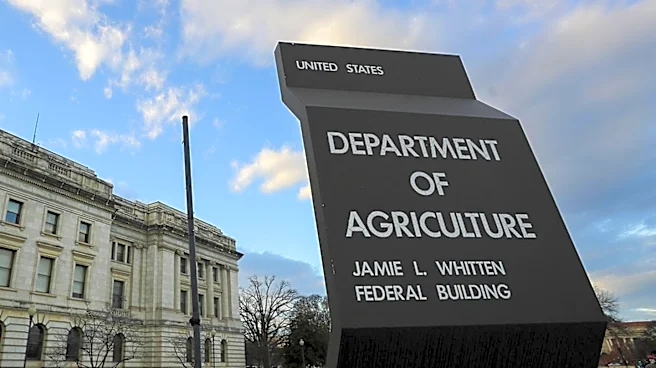
This action by the Trump EPA is significant for American farmers, particularly those operating Animal Feeding Operations, as it removes a long-standing threat of potentially massive fines and legal costs associated with a burdensome regulatory framework. For over two decades, approximately 2,600 AFOs, representing nearly 14,000 farms, have faced uncertainty regarding future permitting or reporting obligations. The EPA's decision to not finalize the methodologies under the 2005 Air Compliance Agreement provides much-needed regulatory certainty, allowing farmers to focus on food production without the specter of outdated and impractical regulations. Deputy Secretary of Agriculture Stephen Alexander Vaden emphasized that an 'activist EPA' had threatened farmers with an 'unnecessary framework,' and this decision ends that threat. While the EPA maintains its commitment to clean air, this move prioritizes the concerns of farmers and aims to prevent red tape from hindering critical food production and impacting rural economies. The decision underscores a broader approach by the Trump administration to resolve outdated agreements that no longer serve their intended purpose, aiming to provide regulatory relief and support to the agricultural sector.
What's Next?
The EPA's enforcement office will proceed with notifying the approximately 2,600 AFOs that were subject to the 2005 Air Compliance Agreement about this action and will work to terminate the agreement. This will officially end the long-standing obligations for these farms. The Trump EPA has stated its intention to continue collaborating with the U.S. Department of Agriculture (USDA), land-grant universities, and producers to find practical, science-based approaches to understand and reduce air emissions from farms. This ongoing collaboration suggests a shift towards more current and relevant data-driven solutions for environmental concerns in agriculture, rather than relying on outdated studies. The administration will continue to prioritize farmers, recognizing their vital role in feeding the nation, and will likely seek to implement policies that balance environmental protection with agricultural viability. Future discussions and initiatives will likely focus on developing new, scientifically credible methods for emission estimation that are representative of modern farming practices, ensuring that any future regulations are both effective and practical for the agricultural industry.
Beyond the Headlines
This decision by the Trump EPA highlights a recurring tension between environmental regulation and economic impact, particularly within the agricultural sector. The initial 2005 agreement, born from a National Academy of Sciences report, aimed to address air emissions from AFOs, reflecting a societal concern for environmental quality. However, the subsequent two-decade delay and eventual termination of the agreement due to outdated data underscore the challenges of implementing long-term environmental policies in rapidly evolving industries. The EPA's acknowledgment that the data from 2005-2007 no longer reflect modern farming practices raises questions about the agility and responsiveness of regulatory bodies to technological advancements and operational changes. This situation also touches upon the broader debate regarding the role of government in regulating industries, with some advocating for stricter environmental controls and others emphasizing the need for regulatory relief to support economic growth and reduce burdens on businesses. The outcome in this case suggests a leaning towards the latter, prioritizing the economic stability and operational certainty of American farms while still affirming a commitment to clean air through alternative, more current approaches.