



What's Happening?
Astronomers from the University of Maryland have discovered a dormant supermassive black hole located far from the center of its host galaxy. This discovery was made possible by an artificial intelligence program that identified a tidal disruption event,
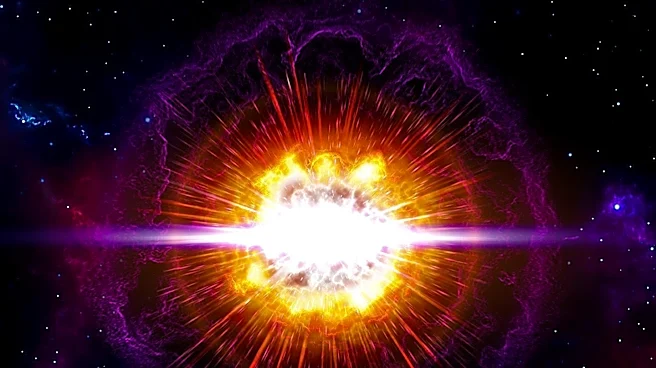
where a star is torn apart by a black hole's gravity, producing a distinctive light pattern. The event was detected using the Zwicky Transient Facility at Palomar Observatory, which surveys the northern sky every two days. The AI system, operational since August 2025, quickly identified the event, leading to the discovery of the black hole. This finding challenges the assumption that supermassive black holes are always located at the centers of galaxies and suggests that wandering black holes may be more common than previously thought.
Why It's Important?
The discovery of a wandering supermassive black hole has significant implications for our understanding of galaxy formation and evolution. It suggests that black holes can be displaced from their original positions during galactic mergers and collisions, leading to a better understanding of how galaxies and their black holes grow over time. This finding also highlights the potential of using AI and machine learning to identify celestial phenomena that are difficult to detect with traditional methods. The ability to find more wandering black holes could provide insights into the number of such objects in the universe and their role in the cosmic landscape.
What's Next?
The research team plans to continue using AI to search for additional wandering black holes, which could help refine models of galaxy formation and black hole dynamics. Future observatories, like the Vera C. Rubin Observatory, are expected to identify many more such objects, enhancing our understanding of the universe. The discovery also sets a precedent for using AI in astronomical research, potentially leading to more breakthroughs in the field.