



What's Happening?
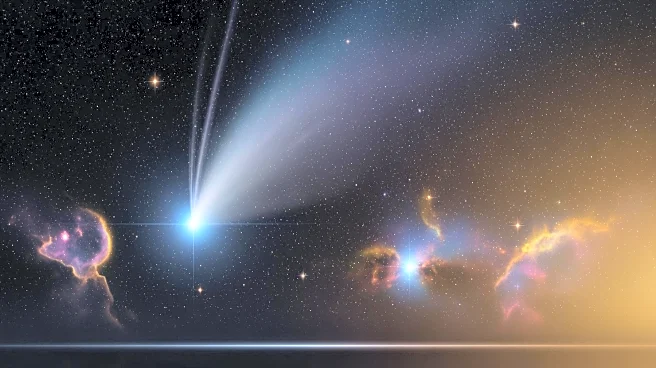
Comet C/2025 R3 (PanSTARRS) is set to reach its closest point to the sun, known as perihelion, on April 20, 2026. During this time, the comet will come within 47.4 million miles of the sun, positioning it between the orbits of Mercury and Venus. The comet is expected
to be at its brightest on April 27, 2026, when it will be closest to Earth, at a distance of 44 million miles. The brightness of comets is notoriously unpredictable, but some forecasts suggest it could reach a magnitude comparable to the brightest stars in the constellation Cassiopeia. The comet's visibility may be enhanced by forward scattering, a phenomenon where sunlight is reflected and scattered towards Earth. Observers in the Northern Hemisphere will have the best view in the predawn sky in late April, while those in the Southern Hemisphere can see it after sunset in early May.
Why It's Important?
The potential visibility of Comet C/2025 R3 (PanSTARRS) offers a significant opportunity for both amateur and professional astronomers to observe a celestial event that could become one of the brightest comets of 2026. Such events can inspire public interest in astronomy and provide valuable data for scientific research. The comet's approach also highlights the importance of ongoing sky surveys and monitoring programs like Pan-STARRS, which discovered the comet. These programs are crucial for tracking celestial objects that could impact Earth or provide insights into the solar system's formation and evolution.
What's Next?
As the comet approaches perihelion, astronomers will continue to monitor its brightness and trajectory. Observatories worldwide are likely to conduct detailed observations to gather data on its composition and behavior. Public interest is expected to grow as the comet becomes more visible, potentially leading to increased engagement with astronomy-related activities and events. The scientific community will also be keen to compare observations of Comet C/2025 R3 with previous comets to enhance understanding of these celestial bodies.