



What's Happening?
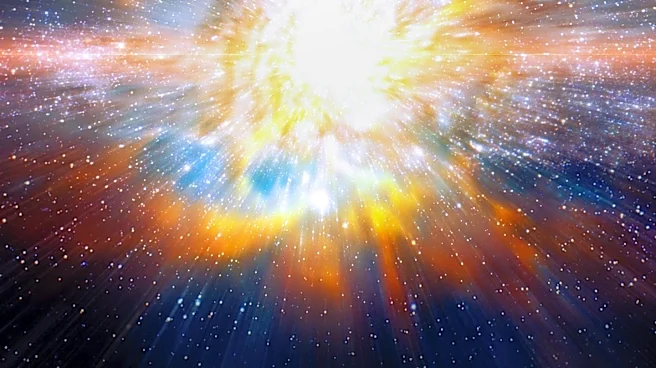
Cosmology is grappling with a significant discrepancy known as the Hubble Tension, where two primary methods for measuring the universe's expansion rate yield conflicting results. One method, based on observations of the cosmic microwave background (the
universe's 'baby picture' from 380,000 years after the Big Bang), indicates an expansion rate of approximately 67.4 kilometers per second per megaparsec (km/s/Mpc). The second method, which measures distances to nearby galaxies using pulsating Cepheid stars, consistently shows a faster rate of about 73 km/s/Mpc. This persistent gap, which has held firm despite years of increasingly precise measurements and advanced instrumentation, suggests that either there is a hidden error in the data or, more profoundly, that the standard model of cosmology may be incomplete or 'broken,' as suggested by John O'Meara, Chief Scientist and Deputy Director of Keck Observatory.
Why It's Important?
The Hubble Tension is not merely a statistical anomaly; it challenges the foundational understanding of the universe's age, its evolution, and its ultimate fate. If the discrepancy points to new physics, it could mean that the universe contains undetected matter or energy, or that gravity behaves differently across cosmic distances than currently theorized. A faster expansion rate implies a younger universe (around 13 billion years old), while a slower rate suggests an older one (closer to 14 billion years). This difference impacts all cosmological estimates, from the formation of the first stars to the age of the Milky Way. The persistence of this tension, even after rigorous attempts to identify measurement errors, indicates a potential need to rewrite significant chapters of physics, fundamentally altering our cosmic rulebook and the models that have successfully explained the universe for decades.
What's Next?
Scientists are actively seeking a completely independent method to measure the universe's expansion rate that does not rely on either the cosmic microwave background or the traditional 'distance ladder.' Gravitational lensing, specifically time-delay cosmography, is emerging as a promising technique. This method uses the bending and delaying of light from distant objects by massive galaxies to calculate the expansion rate. Early results from gravitational lensing measurements tend to align with the faster expansion rate (around 73.3 km/s/Mpc), further reinforcing the reality of the tension. Observatories like the Vera C. Rubin Observatory are expected to discover thousands of new gravitational lenses, which could provide the precision needed to definitively determine whether the Hubble Tension is a measurement error or a signal of new physics, potentially leading to a revised standard model of cosmology.
Beyond the Headlines
The Hubble Tension delves into the philosophical underpinnings of scientific knowledge, questioning the completeness of our most successful cosmological theories. The possibility that the universe's expansion is influenced by 'early dark energy'—a transient repulsive force in the infant universe—or by undiscovered particles like sterile neutrinos or dark radiation, opens up entirely new avenues for theoretical and experimental physics. This ongoing scientific debate highlights the dynamic nature of cosmology, where even well-established models are subject to revision in the face of new, contradictory evidence. The resolution of the Hubble Tension could lead to a profound shift in our understanding of the fundamental constituents and forces of the universe, potentially revealing a more complex and intriguing cosmos than currently imagined, and inspiring a new generation of scientific inquiry.