
What's Happening?
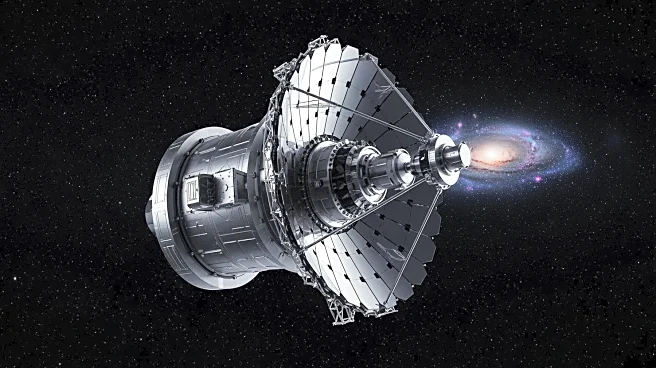
NASA has completed the assembly of the Nancy Grace Roman Space Telescope, a $4.3 billion project initially targeted for cancellation by President Trump. The telescope, named after NASA's first chief astronomer,
is designed to conduct a wide-field survey of the universe, focusing on dark matter and dark energy. With a primary mirror smaller than the James Webb Space Telescope, Roman will cover larger areas of the sky, enabling a comprehensive cosmic census. The telescope is scheduled for launch in fall 2026, following a series of successful tests to ensure its readiness for space conditions.
Why It's Important?
The Roman Space Telescope is expected to revolutionize our understanding of the universe by providing unprecedented data on dark matter and dark energy, which constitute about 95% of the universe. Its wide-field capabilities will allow astronomers to study the structure and evolution of the cosmos on a grand scale. The mission will also complement the James Webb Space Telescope by offering a broader view of the sky, potentially leading to new discoveries about the formation and distribution of galaxies and other cosmic phenomena.
What's Next?
With the telescope's construction complete, NASA will focus on final preparations for its launch in 2026. This includes further testing and integration of scientific instruments. Once operational, the Roman Space Telescope will embark on a five-year mission to survey the universe, with the potential for groundbreaking discoveries in cosmology and astrophysics. The scientific community eagerly anticipates the data that Roman will provide, which could reshape our understanding of the universe.