



What's Happening?
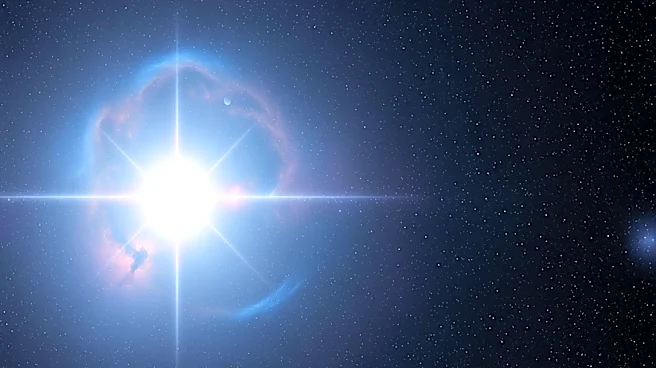
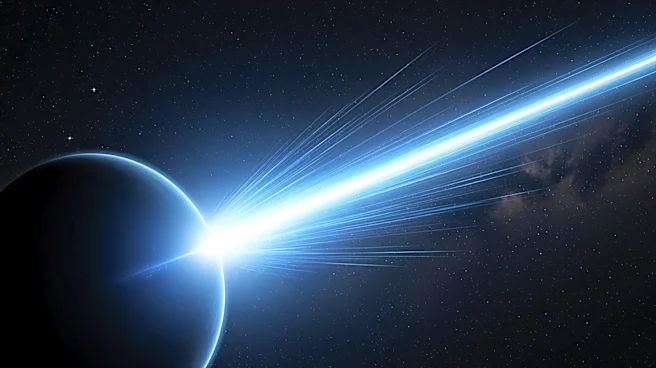
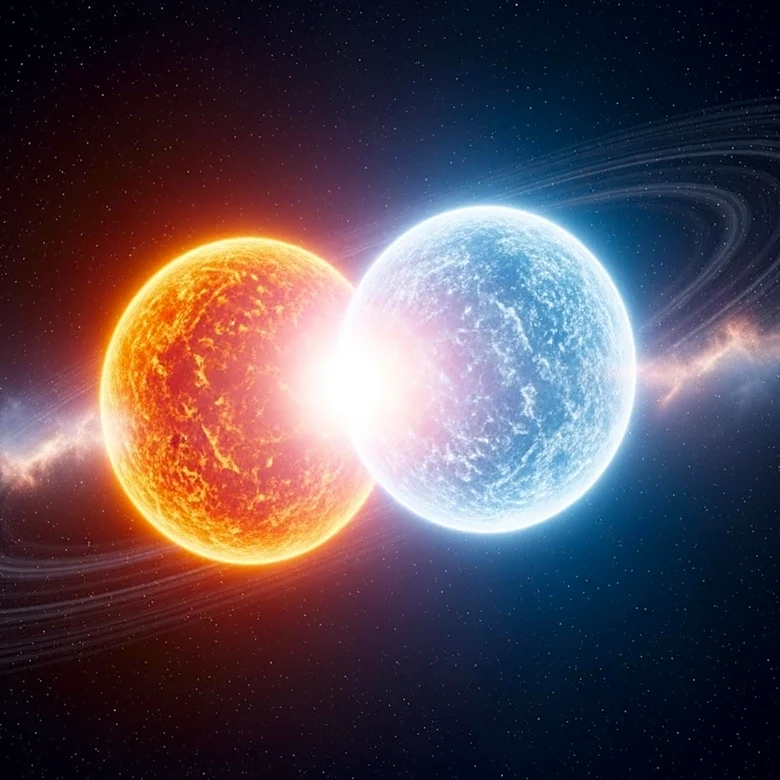
For the first time, scientists have measured the instantaneous power and speed of jets from the black hole Cygnus X-1. Located 7,200 light-years away, this black hole is part of a binary system with a blue supergiant star. The jets, which are equivalent
in power to 10,000 suns, travel at half the speed of light. The research, led by Steve Prabu from the University of Oxford, utilized 18 years of high-resolution radio imaging. The jets are influenced by the stellar wind from the companion star, causing them to bend and wobble. This study, published in Nature Astronomy, marks a significant advancement in understanding black hole dynamics.
Why It's Important?
This breakthrough in measuring the jets' power and speed provides critical insights into the role of black holes in shaping cosmic structures. The jets' ability to carry away 10% of the energy released as matter falls into the black hole is a crucial factor in models of galaxy evolution. Understanding these jets can help scientists comprehend the feedback mechanisms of black holes and their impact on the surrounding environment, potentially influencing theories about the formation and evolution of galaxies.
What's Next?
The research team plans to apply similar measurement techniques to other black holes, which could lead to a more comprehensive understanding of black hole jets across different systems. This could further illuminate the role of black holes in the universe and refine models of cosmic evolution. The findings may also inspire new studies on the interaction between black holes and their environments.