



What's Happening?
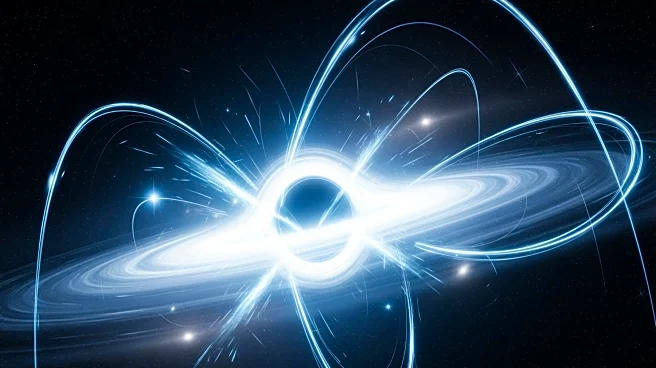
An international team of astronomers has observed a supermassive black hole in the galaxy NGC 3783 ejecting matter at speeds of 60,000 km/sec, the highest ever recorded. This phenomenon was detected using the European Space Agency's XMM-Newton and the X-Ray
Imaging and Spectroscopy Mission (XRISM). The rapid ejection of material is likened to solar coronal mass ejections but on a much larger scale. This discovery provides new insights into the behavior of black holes and their impact on surrounding space.
Why It's Important?
The observation of such high-speed ejections from a black hole enhances our understanding of these enigmatic cosmic entities. It challenges existing theories about black hole behavior and the mechanisms driving such extreme phenomena. This discovery could lead to advancements in astrophysics, particularly in the study of black hole dynamics and their influence on galaxy formation and evolution. The findings also underscore the importance of international collaboration in space research, as it allows for the pooling of resources and expertise to achieve groundbreaking scientific discoveries.
Beyond the Headlines
The study of black holes and their extreme behaviors has broader implications for our understanding of the universe. It raises questions about the fundamental laws of physics and the nature of matter under extreme conditions. The ability to observe and analyze such phenomena also highlights the advancements in space technology and the potential for future discoveries. As research continues, scientists may uncover more about the role of black holes in shaping the cosmos, potentially leading to new theories and models in astrophysics.