





What's Happening?
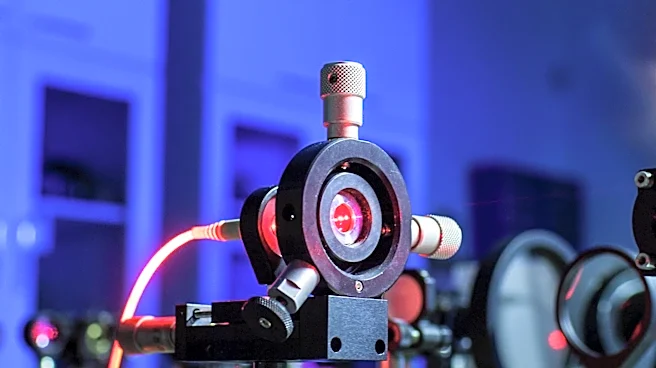
Scientists at the National Institute of Standards and Technology (NIST) have successfully demonstrated a method using quantum mechanics to definitively confirm a person's physical location. This first-of-its-kind experiment, detailed in Nature, utilizes
quantum position verification (QPV) to eliminate loopholes present in previous quantum-based verification strategies. The process involves two verifiers and a prover. One verifier creates entangled photons, sending one to the prover while keeping the other. Both verifiers send random numbers to the prover, who uses them to measure a property of the entangled photon (its polarization). The prover then reports the measurement back. By analyzing the time taken for the response and the correlation of measurements, and by passing a loophole-free Bell test, the ververifiers can ascertain the prover's true location. This method leverages the no-cloning theorem and the cosmic speed limit to prevent fraud, ensuring that only someone physically present at a specific location can access a system.
Why It's Important?
This breakthrough has significant implications for cybersecurity, offering a novel way to anchor digital security to the physical world. Current cybercrimes cost U.S. citizens billions annually, with many perpetrators operating remotely and evading capture. The NIST technique could prevent remote adversaries from accessing sensitive data, issuing commands to critical infrastructure like nuclear plants and power grids, making unauthorized stock transactions, and thwarting phishing attacks. By requiring physical presence for system access, it could safeguard healthcare records, financial networks, and other private information from remote hacking attempts. While practical application is still over a decade away due to the need for advanced quantum communication networks, this research lays a foundational step towards a more secure digital future, where location itself becomes a verifiable security credential.
What's Next?
The immediate next steps involve further development of the necessary quantum communication networks and technologies. NIST and other research organizations are actively working on creating high-fidelity quantum networks capable of sharing entangled photons between users and secure locations, such as banks. This will enable the practical implementation of QPV on a larger scale. Researchers will also focus on refining the quantum sensors and technologies to ensure accuracy and scalability for real-world applications. The goal is to build robust quantum infrastructure that can support secure quantum information sharing across vast networks, ultimately integrating QPV into existing security protocols to enhance protection against sophisticated cyber threats.
Beyond the Headlines
The ethical and legal implications of definitive location verification are profound. While offering enhanced security, such technology could also raise concerns about privacy and surveillance. The ability to precisely confirm someone's location could be a double-edged sword, potentially leading to new forms of tracking or control if not carefully regulated. Furthermore, the development of quantum-resistant cryptography will become even more critical as quantum technologies advance, creating a continuous arms race in cybersecurity. This research also highlights the increasing convergence of physics and information security, pushing the boundaries of what's possible in protecting digital assets and critical infrastructure in an increasingly interconnected world. The long-term societal shift could involve a redefinition of trust in digital interactions, moving from purely digital authentication to authentication rooted in physical presence.